OCD and Anxiety: What's the Difference?

OCD and anxiety share similar feelings, but they are not the same. Learn how to tell them apart, why it matters, and how each is treated in Ireland.
Laura's hands shake before every work meeting. Her heart races, her mouth goes dry, and she spends the hour before imagining everything that could go wrong. She has always called it anxiety. Her GP mentioned generalised anxiety disorder. She tried breathing apps, cut back on caffeine, and practised mindfulness. Some of it helped a little.
But there is another layer she has never named. After every meeting, she replays the conversation in her head for hours. Did she say something embarrassing? Did she offend someone? She checks her sent emails, even though she remembers pressing send only once. She asks her colleague repeatedly whether everything seemed alright. The relief lasts minutes. Then the doubt starts again.
Laura is not just anxious. Part of what she is experiencing fits the pattern of obsessive-compulsive disorder. The two conditions often overlap, but they are not the same. Understanding the difference can change what kind of help you seek and how quickly you start to feel better.

What Anxiety Actually Is
Anxiety is a natural stress response. It becomes a problem when it is frequent, intense, and out of proportion to the situation. Generalised anxiety disorder involves persistent worry about everyday concerns: health, work, money, relationships, or the future. The worry feels difficult to control and can come with physical symptoms like tension, fatigue, irritability, and sleep problems.
Other anxiety disorders have more specific triggers. Panic disorder involves sudden surges of fear. Social anxiety centres on fear of judgement in social situations. Specific phobias focus on particular objects or experiences. What they share is a sense of threat or danger, even when the threat is not immediate.
Anxiety is exhausting. It can make people avoid situations, overprepare, or seek constant reassurance. But the thoughts are usually about real-life concerns, even if the worry is exaggerated. The person is anxious about something.

What OCD Actually Is
OCD also involves anxiety, but it is driven by a specific cycle: intrusive thoughts, images, or urges that feel unacceptable, followed by compulsions performed to neutralise the distress or prevent a feared outcome.
The intrusive thoughts in OCD are often ego-dystonic, which means they conflict with the person's values and sense of self. Someone who values kindness might have intrusive thoughts about harming others. Someone who loves their partner might have thoughts about not loving them. Someone who values their faith might have blasphemous thoughts. The content can be deeply upsetting precisely because it is so opposite to who the person wants to be.
The compulsions can be visible, like checking or washing. They can also be mental, like counting, praying, reviewing memories, or trying to "cancel out" a thought with another thought. The person usually knows the compulsion does not make logical sense, but the anxiety feels so urgent that they do it anyway.
"The key difference is that OCD is not simply anxiety about life stressors. It is a disorder of intrusive thoughts and compulsive rituals that temporarily reduce distress but keep the problem alive." — Dr. Fiona McNicholas, consultant child and adolescent psychiatrist and OCD researcher
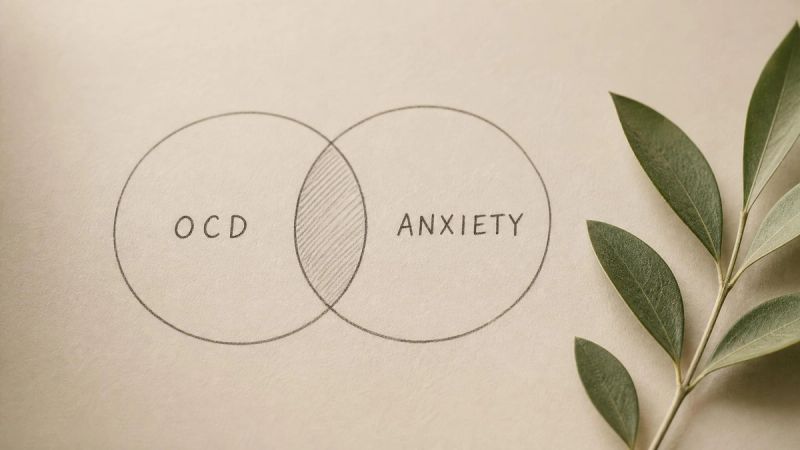
How the Two Conditions Overlap
It is very common for someone to have both anxiety and OCD. The HSE notes that anxiety disorders and OCD often occur alongside one another. In fact, many people with OCD are first diagnosed with anxiety because the OCD cycle is not recognised.
The overlap can make symptoms harder to untangle. Both can cause:
- Restlessness and difficulty concentrating
- Sleep problems
- Avoidance of certain situations
- Physical symptoms like a racing heart or muscle tension
- Reassurance-seeking from others
The difference often lies in what drives the distress. In anxiety, the fear is usually about a real or plausible future event. In OCD, the fear is often triggered by an intrusive thought, and the person uses rituals to try to remove uncertainty or prevent something that feels catastrophic but is unlikely.

Why the Difference Matters
Getting the right diagnosis matters because the treatments, while similar in some ways, are not identical. Both anxiety and OCD can be treated with cognitive behavioural therapy, but OCD usually requires a specific form called exposure and response prevention, or ERP.
General anxiety treatment might focus on relaxation, challenging worried thoughts, and gradual exposure to feared situations. ERP for OCD focuses on resisting the compulsive response to intrusive thoughts, whether that response is physical or mental. Without ERP, therapy for OCD can accidentally become another form of reassurance, which keeps the cycle going.
Medication can help both conditions, particularly SSRIs. However, OCD often requires higher doses than anxiety disorders, and the response can take longer. A psychiatrist or GP with experience in both conditions can help tailor the approach.
If you are trying to understand your own symptoms, our article on what OCD is and how it shows up in Ireland walks through the signs in more detail.

Spotting the Patterns in Yourself
A few questions can help you notice whether your experience leans more toward general anxiety or OCD:
- Do your worries centre on real-life events, or do they involve intrusive thoughts that feel alien to you?
- Do you perform specific rituals, mentally or physically, to reduce distress?
- Does reassurance from others help for more than a short time, or does the doubt return quickly?
- Do you avoid situations not because they are dangerous, but because they might trigger an intrusive thought?
- Do you spend a lot of time trying to "solve" or analyse your thoughts?
If several of these point toward OCD, it is worth speaking to a clinician who understands both conditions. The right assessment can make a real difference to the treatment path.

Treatment in Ireland
In Ireland, both anxiety and OCD are treated through HSE mental health services, private therapy, and online services. A GP can assess your symptoms and refer you to the appropriate service. For mild to moderate symptoms, primary care psychology may be suitable. For more persistent or severe symptoms, community mental health services or a private psychiatrist or clinical psychologist may be better.
When looking for a therapist, it helps to ask whether they have experience with both anxiety disorders and OCD, and whether they use ERP for OCD specifically. Not all CBT therapists are trained in ERP, and treating OCD with general anxiety techniques alone can be less effective.
Online therapy is a practical option if waiting lists are long in your area or if you prefer the flexibility of remote sessions. Many accredited Irish therapists offer CBT and ERP online across the country.
"Accurate diagnosis is the foundation of effective treatment. When OCD is mistaken for general anxiety, people can spend years in therapy without addressing the compulsions that keep their symptoms going." — Dr. Jon Abramowitz, professor of psychology and OCD researcher at UNC Chapel Hill

Frequently Asked Questions
Can you have OCD and anxiety at the same time?
Yes. It is very common for people with OCD to also have an anxiety disorder such as generalised anxiety disorder, social anxiety, or panic disorder. They can fuel each other, so a thorough assessment is important.
Is OCD a type of anxiety disorder?
OCD was previously classified as an anxiety disorder, but it is now listed separately in diagnostic manuals such as DSM-5 under obsessive-compulsive and related disorders. It is closely related to anxiety but has its own diagnostic criteria and treatment focus.
How do I know if I have OCD or just anxiety?
The strongest clue is the presence of intrusive thoughts followed by compulsions or rituals. If your distress is driven by unwanted thoughts that you try to neutralise, and the relief is only temporary, OCD may be part of the picture. A clinical assessment is the best way to know for sure.
Is the treatment different for OCD and anxiety?
Both can be treated with CBT, but OCD usually requires ERP, which specifically targets the compulsion cycle. Medication doses and response times can also differ. A clinician familiar with both can recommend the right approach.
Where can I get help in Ireland for OCD or anxiety?
Start with your GP. They can refer you to HSE services or recommend a private therapist. You can also search the IACP or PSI directories, or use an online therapy service to get matched with an accredited therapist.

You Can Get the Right Kind of Help
Whether you are dealing with anxiety, OCD, or both, the important thing is that you do not have to manage it alone. The symptoms can feel messy and overlapping, but a good assessment can bring clarity. Once you know what you are working with, the right treatment becomes much clearer.
Many people spend years assuming they are just anxious, when part of the problem is actually OCD. Recognising the difference is not about labels. It is about finding the approach that actually works for your brain.
If you would like to speak with an accredited Irish therapist who understands both anxiety and OCD, you can get matched with a therapist through Feel Better Therapy. Sessions are available online across Ireland, so you can access support that fits your life.

Related Articles
- OCD Therapy Ireland: A Complete Guide
- What Is OCD? Signs, Symptoms and Causes in Ireland
- ERP Therapy for OCD in Ireland
- OCD in Adults: Diagnosis, Treatment and Living Well
This article is for informational purposes only and does not constitute medical advice. If you are in crisis, please contact Samaritans Ireland at 116 123 or Pieta House at 1800 247 247.