Online Couples Therapy: Strengthening Irish Relationships from Home

Discover how online couples therapy helps Irish partners navigate relationship challenges. Learn about effective formats, cultural considerations, and finding the right therapist.
Irish relationships face unique pressures. The housing crisis means many couples live with parents longer than they'd like. The cost of childcare forces difficult decisions about work and family. Rural isolation, emigration of friends, and the lingering effects of Catholic guilt around relationships all shape how Irish couples experience partnership.
When relationships struggle, traditional couples therapy often presents barriers. Finding time when both partners are free, arranging childcare, travelling to appointments—it's enough to make many couples abandon the idea before they start. Online couples therapy removes these obstacles, allowing partners to attend sessions from home, perhaps after children are asleep, without the logistical complexity of coordinating two schedules plus travel.
This guide explores how online couples therapy works, what issues it addresses effectively, and how Irish couples can access quality relationship support without leaving their homes.
How Online Couples Therapy Works
The format differs from individual therapy in important ways. Understanding these differences helps set appropriate expectations.
The structure of sessions typically involves both partners attending together, though some therapists also schedule individual sessions with each partner. The joint sessions focus on communication patterns, conflict resolution, and shared goals. Individual sessions allow each partner to explore personal contributions to relationship difficulties without the other present.
Video platforms enable the same visual connection as in-person work. Therapists observe body language, facial expressions, and the subtle interactions between partners. Many couples report feeling more comfortable in their own homes, leading to more authentic expression than in a clinical environment.
The therapist's role remains consistent regardless of format: facilitating productive communication, identifying destructive patterns, and teaching skills for healthier interaction. Online therapists use the same evidence-based approaches—Emotionally Focused Therapy, Gottman Method, Imago Relationship Therapy—as their in-person colleagues.
Homework and between-session work often increases with online therapy. Since you're already at home, therapists may assign communication exercises to practice in your actual environment, reporting back in the next session. This immediate application accelerates progress.
Issues Online Couples Therapy Addresses Effectively
Not every relationship issue suits online work, but many common problems respond well to virtual treatment.
Communication difficulties are perhaps the most common reason couples seek therapy, and online sessions address these effectively. Therapists observe how partners speak to each other, interrupt, or avoid difficult topics. They teach active listening skills, "I" statements, and structured dialogue techniques that partners practice in real-time during sessions.
Conflict patterns become visible in the familiar environment where they typically occur. A therapist might notice how one partner shuts down when tension rises, or how criticism escalates quickly. The home setting can actually provide more authentic examples of problematic interactions than a clinical office where couples might be on their best behaviour.
Intimacy and sexual difficulties can be addressed online, though some couples initially feel awkward discussing these topics via video. Experienced therapists create safety for these conversations, and many couples find the slight distance of the screen makes vulnerable disclosures easier.
Life transitions—becoming parents, career changes, relocation, bereavement—often strain relationships. Online therapy provides support during these periods without adding logistical stress. For new parents particularly, attending therapy while a baby naps nearby can be the only viable option.
Trust violations including infidelity require careful navigation. Online therapy can address these issues, though severe betrayals may initially need more intensive support. The key factor is both partners' commitment to the process, regardless of format.
Premarital counselling works excellently online. Couples planning marriage can explore expectations, values, and potential conflict areas before making legal commitments. The convenience means busy couples actually complete this valuable preparation.
The Irish Context: Cultural Factors in Relationship Therapy
Irish couples bring specific cultural backgrounds into therapy that affect how problems manifest and resolve.
The communication legacy of Irish culture—indirect expression, emotional restraint, the famous inability to accept compliments—shapes relationship difficulties. Many Irish adults grew up in homes where difficult emotions weren't discussed, leaving them without models for healthy conflict. Therapy must explicitly teach skills that other cultures might absorb naturally.
The housing situation creates unique pressures. Couples living with parents or in-laws face privacy challenges that strain intimacy. Those renting fear eviction if they request repairs or assert boundaries. First-time buyers experience enormous financial stress. These external pressures become relationship problems, requiring therapy to address both the practical and emotional dimensions.
Alcohol and Irish social life intersect with relationship difficulties in complex ways. Many couples find their social connections centre on drinking, making it difficult to maintain friendships while reducing alcohol. Therapy often explores how alcohol functions in the relationship—social lubricant, conflict avoidance, or source of conflict itself.
Gender roles have shifted dramatically in Ireland over a generation, but not without friction. Couples often struggle with unequal division of domestic labour despite both working full-time. The mental load of household management falls disproportionately on women. These aren't individual failings but systemic issues that therapy helps couples navigate consciously.
Religious and cultural backgrounds vary enormously in modern Ireland. Couples from different backgrounds—Catholic and Protestant, Irish and immigrant, urban and rural—may discover unexpected value differences. Online therapy allows access to culturally competent therapists regardless of geographic location.
Choosing an Online Couples Therapist
Not all therapists who work with individuals are skilled at couples work. Specific expertise matters enormously.
Couples therapy training should be explicit. Ask prospective therapists what specific training they've completed in couples work—general counselling qualifications don't include the specialised skills needed for relationship therapy. Look for training in recognised approaches: Gottman Method, Emotionally Focused Therapy (EFT), or Imago Relationship Therapy.
Experience with online couples work is increasingly common but still worth confirming. Couples therapy online has different dynamics than individual online therapy—the therapist must manage three people on screen, observe interaction patterns, and maintain safety when conflict escalates. Ask specifically about their online couples experience.
The initial consultation reveals much about the therapist's approach. Do they speak with both partners equally? Do they seem comfortable with relationship conflict? Do they offer specific observations or just general support? The consultation should give you confidence in their competence.
Cost considerations for couples therapy typically run higher than individual work—€100-€150 per session reflects the complexity of working with two people and their relationship system. Some therapists offer sliding scales, and the investment compares favourably to the costs of relationship breakdown.
Ireland-specific factors include time zone convenience for therapists based elsewhere, understanding of Irish legal frameworks around marriage and cohabitation, and cultural competence with Irish relationship patterns. While many excellent therapists work internationally, these factors merit consideration.
What to Expect: The Process of Online Couples Therapy
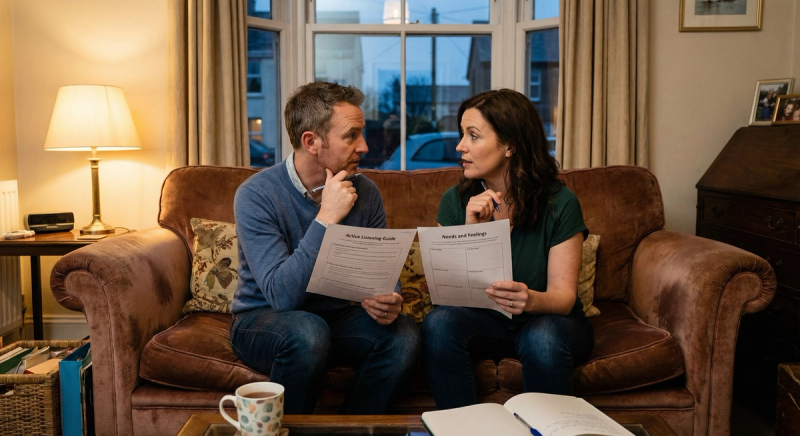
Understanding the typical arc helps couples commit to the process without unrealistic expectations.
The assessment phase (typically 1-2 sessions) involves understanding your relationship history, current difficulties, and goals for therapy. The therapist observes how you interact, identifies patterns, and begins formulating an understanding of your relationship system. Both partners should feel heard during this phase.
The middle phase involves active work on communication, conflict resolution, and understanding each other's perspectives. This is where skills are taught and practiced, where old patterns are challenged, and where new ways of relating are established. Progress isn't linear—expect setbacks alongside breakthroughs.
The consolidation phase focuses on maintaining gains and preventing relapse. You'll review what you've learned, identify potential future challenges, and establish how to handle difficulties without returning to therapy. Good therapy aims to make itself unnecessary.
Session frequency typically starts weekly, reducing to fortnightly as progress solidifies. Many couples need 12-20 sessions for significant improvement, though this varies enormously based on issue complexity and couple motivation.
Between-session work accelerates progress. Expect homework—communication exercises, reading, reflection questions. Couples who engage with this work see faster results than those who treat sessions as standalone events.
When Online Couples Therapy May Not Be Suitable

While online therapy suits many couples, certain situations warrant in-person or alternative approaches.
Active domestic abuse requires safety planning that online therapy cannot provide. If one partner fears the other, joint therapy—online or in-person—may be contraindicated. Individual safety assessment should precede any couples intervention.
Severe mental health crises in either partner may need individual stabilisation before couples work becomes productive. When depression, addiction, or psychosis dominates, individual treatment often takes priority.
Lack of privacy at home undermines online therapy's effectiveness. If you cannot speak freely because children, housemates, or thin walls compromise confidentiality, in-person sessions or finding an alternative private space becomes necessary.
Significant technology barriers affect some couples. If reliable internet, private devices, or technical comfort are lacking, the format itself becomes a stressor. However, most Irish households now have sufficient technology for video sessions.
One partner unwilling cannot be overcome by any therapy format. Both partners must engage genuinely for couples therapy to work. If one attends under duress or refuses to participate meaningfully, individual therapy for the willing partner may be more productive.
Making It Work: Practical Tips for Online Couples Therapy
Success depends partly on how you approach the format.
Create genuine privacy. If children are home, arrange for them to be occupied in another room with a trusted adult. Turn off notifications on devices. Use headphones if sound carries. The more you can replicate the confidentiality of an office, the more effective sessions will be.
Position the camera to include both of you. The therapist needs to see both partners' reactions and interactions. Test your setup beforehand. Ensure lighting allows clear visibility—backlighting from windows makes faces difficult to read.
Minimise distractions. Close other applications on your device. Put phones on silent. Treat the session with the same attention you'd give an in-person appointment. The convenience of home shouldn't mean casualness about the work.
Have resources ready. Keep notebooks for each partner, any worksheets from previous sessions, and a way to take notes during the session. Some therapists share documents via screen sharing—having a way to view these helps.
Plan transition time. Don't schedule sessions immediately before or after stressful commitments. Give yourselves ten minutes beforehand to shift into therapy mode, and some unscheduled time afterwards to process before returning to daily demands.
Address technology problems proactively. Have a backup plan—phone number for the therapist, alternative device, understanding of how to reconnect if dropped. Technical difficulties happen; how you handle them together becomes part of the therapy.
The Investment in Your Relationship
Couples therapy represents significant investment—of money, time, and emotional energy. Understanding its value helps justify this commitment.
The cost of relationship breakdown far exceeds therapy costs. Separation involves legal fees, establishing separate households, childcare complications, and emotional toll. Even staying together unhappily has costs—to mental health, physical health, children's wellbeing, and productivity. Therapy that prevents these outcomes offers enormous return on investment.
The skills learned extend beyond the current relationship. Communication, conflict resolution, emotional awareness—these benefit all relationships, including those with children, family, and friends. Couples therapy becomes personal development that serves you throughout life.
Modeling healthy relationship skills for children may be the most valuable outcome. Children absorb how adults handle conflict, express needs, and maintain connection. Couples who do this work demonstrate that relationships require active maintenance and that seeking help is healthy.
The convenience of online delivery makes therapy accessible to couples who couldn't manage in-person sessions. The reduced friction means more couples actually get help rather than remaining stuck in dissatisfaction. Removing barriers to care is itself a significant benefit.
Irish couples face real challenges, but they also possess deep resources—humour, loyalty, pragmatism, and commitment to family. Online couples therapy helps access these resources, building relationships that can withstand external pressures and internal difficulties. The format fits modern Irish life, meeting couples where they are and supporting them in building the partnerships they want.
Related Guides:
Related Guides:
This article is part of The Ultimate Guide to Online Therapy in Ireland — our comprehensive hub covering everything you need to know about virtual mental health support.