Choosing Between Online and In-Person Therapy in Ireland

Compare online and in-person therapy to find your best fit. Learn about practical differences, therapeutic outcomes, and how to choose the right format for your needs.
The decision between online and in-person therapy isn't as straightforward as it might appear. Both formats offer genuine therapeutic benefits, and both have limitations that might make one more suitable than the other depending on your circumstances. Understanding these differences helps you make an informed choice about which format will serve you best.
Irish therapy clients face specific considerations when making this decision. Geographic isolation affects rural residents differently than Dubliners. The housing crisis means many young adults lack private space for online sessions at home. Cultural attitudes toward mental health influence whether people prefer the anonymity of online therapy or the more traditional in-person experience.
This guide compares online and in-person therapy across practical, therapeutic, and personal dimensions to help you choose the approach that fits your life, your needs, and your circumstances.
The Practical Comparison: Logistics and Convenience
Practical factors often dominate the decision between online and in-person therapy. Understanding how each format fits into daily life clarifies which might work better for you.
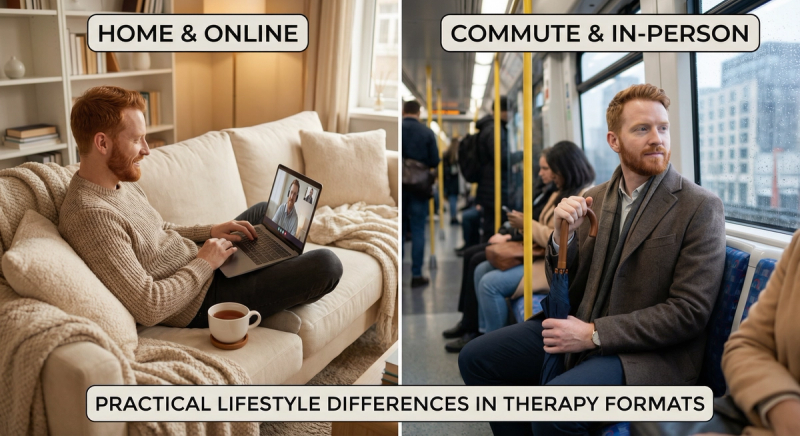
Travel and time commitment distinguishes the formats dramatically. In-person therapy requires travelling to the therapist's location, finding parking or navigating public transport, and accounting for the time this consumes. For Dublin residents, this might mean 30-45 minutes each way. For rural clients, travel could consume half a day. Online therapy eliminates this entirely—you simply open your device at the appointed time.
Geographic access opens up dramatically with online therapy. Living in rural Ireland no longer limits you to whatever practitioners happen to work within driving distance. Online therapy connects you with specialists across the entire island. Conversely, in-person therapy ties you to local availability, which may be limited or non-existent in some areas.
Scheduling flexibility generally favours online therapy. Therapists offering online sessions often provide early morning, evening, or weekend appointments that accommodate work schedules. The format also eliminates the "travel buffer"—you don't need to leave work early or arrange childcare to attend. In-person therapy typically requires more rigid scheduling around the therapist's office hours and your availability to travel.
Physical accessibility varies by individual circumstances. For those with mobility limitations, chronic illness, or caregiving responsibilities that make leaving home difficult, online therapy removes significant barriers. For others, the routine of leaving home for therapy provides valuable structure and separation that enhances the therapeutic experience.
Privacy considerations differ between formats. Online therapy offers complete anonymity—you won't be seen entering a therapy clinic or sitting in a waiting room. However, it requires private space at home, which not everyone has. In-person therapy requires travelling to a visible location but guarantees a confidential, soundproofed environment for the session itself.
The Therapeutic Experience: Does Format Affect Outcomes?
Research consistently shows that both online and in-person therapy produce equivalent outcomes for most mental health conditions. However, the therapeutic experience differs in ways that may matter for your specific situation.
The therapeutic relationship forms effectively in both formats. Studies comparing online and in-person therapy find no significant difference in the quality of client-therapist connection or the strength of the working alliance. Good therapists build rapport regardless of medium—it's the human connection that matters, not the technology.
Non-verbal communication presents differently online. In-person, therapists observe your full body language, posture, and movement through physical space. Online sessions show only your upper body and face, potentially missing cues that might be visible in person. However, video quality and camera positioning have improved dramatically, and skilled therapists adapt their observation to the medium.
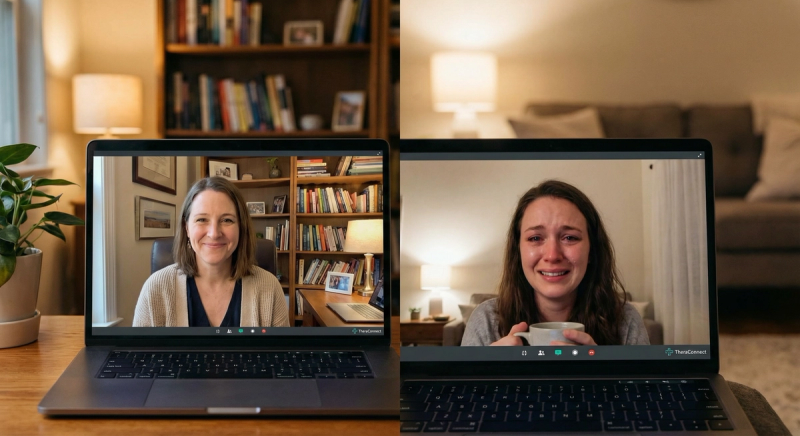
Therapeutic containment—the sense of safety and boundary that therapy provides—varies by format. Some clients find the physical therapy room creates a special space where they can access difficult emotions more easily. Others feel more comfortable exploring vulnerability from their own familiar environment. Neither is objectively better—it depends on your personal response.
Certain modalities transfer better than others. CBT, talk therapy, and counselling adapt seamlessly to online delivery. EMDR for trauma has been successfully adapted for online use, though some practitioners prefer in-person for complex cases. Somatic therapies focusing on body awareness and physical experience may work less well online. Discuss with potential therapists whether their approach suits your preferred format.
Crisis management differs between formats. In-person therapists can respond immediately to severe distress within the session room. Online therapists have protocols for handling crises remotely—knowing your location, having emergency contacts, coordinating with local services—but the physical distance requires different safety planning.
Personal Factors: Who Benefits from Each Format?
Individual circumstances often determine which format suits you better.
Online therapy suits you if: you live in a rural area with limited local therapists; your schedule makes travel to appointments difficult; you travel frequently for work; you have mobility limitations or chronic illness; you feel anxious about attending in-person appointments; you prefer the anonymity of online delivery; you have reliable private space at home for sessions; you're comfortable with technology.
In-person therapy suits you if: you have difficulty creating private space at home; you find screens distracting or draining; you value the ritual of leaving home for therapy; you process emotions better in a dedicated therapeutic space; you have complex trauma that might benefit from the containment of a therapy room; you prefer face-to-face communication; you have unreliable internet or technology access; you simply feel more comfortable with traditional formats.
Your specific mental health needs also influence the decision. Severe depression might make leaving home for therapy impossible—online becomes the only viable option. Social anxiety might respond well to online therapy initially, with transition to in-person as confidence builds. Complex trauma might benefit from the safety and containment that a physical therapy room provides. Discuss these factors with potential therapists—they can advise which format suits your specific presentation.
Life circumstances shift over time. Someone might start therapy online during a busy period, then transition to in-person when work calms down. A rural client might begin with the local therapist available in-person, then switch to online when that practitioner leaves the area. The formats aren't mutually exclusive—many people use both at different times.
Making the Choice: Practical Decision Framework
If you're undecided, this framework helps clarify which format suits your current circumstances.
Start with practical constraints. Do you have reliable internet and a private space for online sessions? Is there a suitable therapist within reasonable travel distance? Does your schedule accommodate travel time? These practical factors often make the decision for you—if you can't access in-person therapy logistically, online becomes your option, and vice versa.
Consider your therapy goals. What do you hope to achieve? Are you seeking support through a difficult period, or addressing deep-seated patterns requiring intensive work? Brief, solution-focused therapy adapts well to either format. Longer-term depth psychotherapy might benefit from the containment of in-person work, though many clients successfully engage in deep therapy online.
Reflect on your past experiences. If you've tried therapy before, which format worked for you? Previous positive experiences with one format suggest it might suit you again. If therapy hasn't helped in the past, trying the opposite format might provide different results.
Trial both if uncertain. Many therapists offer brief consultations to assess fit—try an online consultation with one practitioner and an in-person meeting with another. See which feels more comfortable, which therapist you connect with better, and which logistics work for your life. The therapist matters more than the format for outcomes.
Remember you can switch. Starting with one format doesn't commit you to it indefinitely. Many clients begin online due to convenience, then transition to in-person when circumstances allow. Others start in-person, then switch to online when they move or their schedule changes. Therapy should adapt to your life, not the reverse.
Hybrid Approaches: The Best of Both Worlds
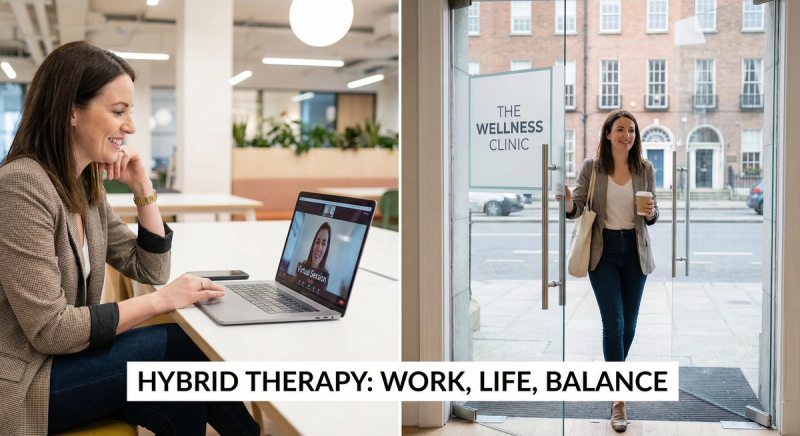
Some therapists and clients are developing hybrid models that combine online and in-person sessions.
Mixed format therapy might involve monthly in-person sessions supplemented by fortnightly online appointments. This maintains the therapeutic depth of face-to-face work while reducing travel burden. It suits clients who value in-person connection but struggle with the logistics of weekly travel.
Intensive blocks combine formats strategically. A client might attend an intensive week of daily in-person sessions, then maintain progress through monthly online check-ins. This suits those who live far from specialist therapists but can occasionally travel for concentrated treatment.
Crisis vs maintenance uses different formats for different needs. In-person sessions might address acute difficulties requiring intensive support, while online sessions maintain progress during stable periods. This flexibility maximises the benefits of each format.
Transition periods between formats can be deliberate therapeutic choices. A client might begin online to overcome initial anxiety about therapy, then transition to in-person as confidence builds. Or they might start in-person to establish the therapeutic relationship, then switch to online when work demands increase.
Not all therapists offer hybrid options—discuss this explicitly if it interests you. The flexibility requires clear communication about scheduling, fees, and how the different formats integrate into your treatment plan.
The Irish Context: Local Considerations
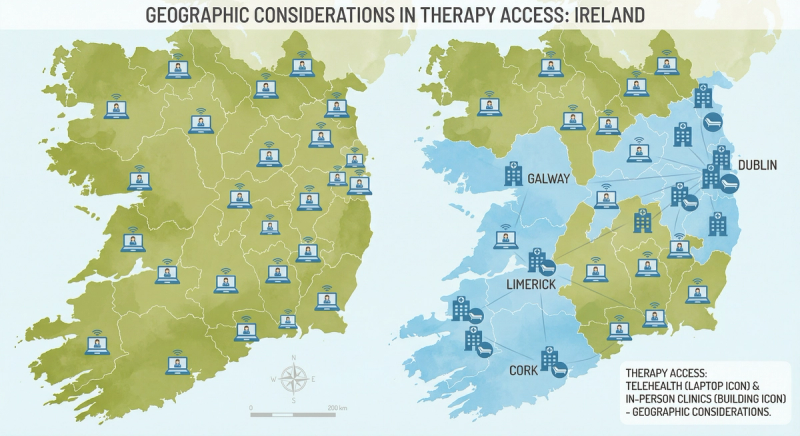
Irish geography and infrastructure create specific factors in the online versus in-person decision.
Rural Ireland faces particular challenges. Many counties have limited local therapists, making in-person therapy practically impossible without significant travel. Online therapy has revolutionised access for rural communities—something particularly valuable given Ireland's high rural population and dispersed settlement patterns.
Urban pressures differ. Dublin, Cork, and Galway have abundant therapists, making in-person therapy geographically feasible. However, traffic, parking costs, and housing density create their own barriers. Dubliners might face 45-minute commutes for a 50-minute session—three hours total commitment that online therapy eliminates.
Broadband reliability varies enormously. Urban areas generally have fibre broadband that supports seamless video therapy. Rural broadband remains problematic in many areas—patchy connections, slow speeds, or complete unavailability make online therapy impossible regardless of preference. Check your connection quality before committing to online format.
Cultural factors influence preferences. Older Irish adults often prefer traditional in-person therapy, viewing it as more "serious" or legitimate. Younger generations frequently prefer online delivery, seeing it as normal and convenient. Neither preference is wrong—therapy should fit your comfort level.
Weather and transport affect Ireland specifically. Winter darkness, rural flooding, and public transport limitations can make travelling to in-person therapy genuinely difficult for months of the year. Online therapy provides consistency regardless of weather—no cancelled sessions due to storms or impassable roads.
Final Thoughts: Trust Your Instincts
Research and practical analysis help, but ultimately the right choice is the one that feels right for you.
The therapist matters more than the format. A skilled, compassionate therapist working online will help you more than a mediocre therapist in person, and vice versa. Focus on finding someone with appropriate expertise with whom you feel comfortable—the format is secondary.
Therapy is an investment in yourself. Whether you choose online or in-person, you're committing time, money, and emotional energy to your wellbeing. This investment pays dividends across every area of life. Don't let the decision paralyse you—both formats work, and starting therapy matters more than perfect format selection.
Flexibility is possible. Your needs may change. What works now might not work in six months. Therapy should adapt to your life circumstances, not require you to contort your life around therapy logistics.
Trust the process. Whether through a screen or across a room, therapy works when you engage openly with a qualified practitioner. The format is simply the container—the healing happens through the relationship, the insights, and the changes you make. Choose the container that lets you show up fully, then commit to the work.
Both online and in-person therapy have transformed thousands of Irish lives. The question isn't which format is objectively better—it's which format better serves you, right now, given your circumstances, preferences, and needs. Answer that question honestly, and you'll find your way to the support you deserve.
Related Guides:
Related Guides:
This article is part of The Ultimate Guide to Online Therapy in Ireland — our comprehensive hub covering everything you need to know about virtual mental health support.
- **How Much Does Online Therapy Cost?** — Understanding pricing
- **Online Couples Therapy** — Relationship support
- **From Burnout to Balance** — Managing workplace stress