Separation vs Divorce in Ireland: What's the Difference and What It Means for You

Separation and divorce aren't the same thing in Ireland. Learn the three legal routes, what each one means for you, and where to get free support.
You're at the kitchen table with a page of notes in front of you, and three phrases keep coming back: separation agreement, judicial separation, divorce. Your solicitor said all three in one sentence. Your sister has opinions. Someone at work told you it's "all the same thing these days," and you've been quietly hoping that's true, because the alternative means there's something you should have understood by now and don't.
Here's the part nobody says out loud: almost everyone learns this vocabulary at the worst possible moment, in the middle of living it. And the words aren't interchangeable. In Ireland they describe three different legal arrangements, with different consequences for your marriage, your right to remarry, and how money, property and children get sorted. Knowing which one you're actually dealing with takes some of the fog out of the next few months.

What Separation Actually Means in Ireland
Separation, in plain English, is a description of how you're living, not a legal status. Two people who were married and now live apart are separated. Nothing has to be signed or stamped for that to be true.
The Central Statistics Office recognises this in its own data. It separates people who are "separated (informal)" — apart by agreement, without any court order — from those who are "judicially separated (formal)", meaning a court has granted a decree. The distinction is worth holding onto, because the options available to you depend on which one you are.
There's a third state that surprises people: still under the same roof, long after the relationship ended. Housing costs and shortages of rental property keep plenty of Irish couples in that position for months. Legally you're not separated in any formal sense. Emotionally, the separation started a long time ago. Both things are true at once.
The Three Routes, Side by Side
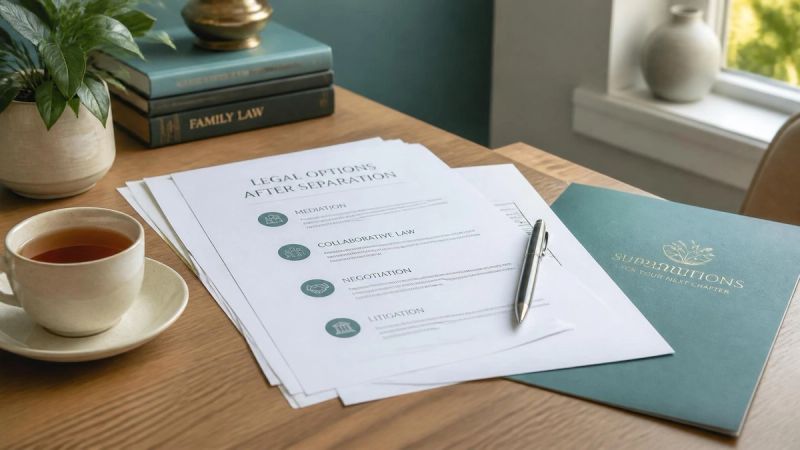
Irish law gives married couples and civil partners three ways forward. Citizens Information sets them out clearly, and it's worth seeing them next to each other:
- Separation agreement. The two of you set the terms for living apart. No court needs to approve it, and it can be drafted with solicitors involved on both sides. It's usually the cheapest and most private option, and it only works if you can both agree.
- Judicial separation. One of you asks a court to decide the terms because agreement isn't reachable. A judge sets out how you'll live separately, including finances, the family home and children. Crucially, the marriage isn't dissolved.
- Divorce. A court grants a decree that ends the marriage. Only then can either of you remarry.
Read that middle bullet again, because it's where most of the confusion lives. Judicial separation sounds final — it goes through a courtroom, a judge, an order — but it leaves you married. A separation agreement does the same. If remarriage matters to you, or if your circumstances might change in ways that require a clean legal break, that difference decides which route you need.
Why the Difference Shows Up Everywhere
The most obvious consequence is remarriage. A separation agreement or a judicial separation doesn't dissolve your marriage, so you can't marry again while either is in place. A decree of divorce does dissolve it.
Less obvious consequences follow you into paperwork. Your marital status on a form, your entitlements under a pension scheme, what happens to your estate if you die without an updated will — all of it depends on whether you're married in the eyes of the law. Couples who separated informally years ago and never formalised anything are sometimes surprised to find they're still legally married when a pension or an inheritance question comes up.
Courts.ie adds an important safeguard. When a judge is making orders for divorce or judicial separation, they must be satisfied that proper provision is made for both spouses and any dependent children. That means looking at each person's income and assets, the standard of living the family had, housing needs and the arrangements for children. If you and your spouse have reached your own agreement, the judge will consider it as part of the order rather than ignore it.

Mediation, and Why the Law Pushes You Towards It
The Mediation Act 2017 changed the default in Ireland. Couples are to be offered mediation as an alternative to court. If you're legally represented, any court application has to include a declaration from your solicitor confirming you were told about it. This isn't a box-ticking formality in practice, because mediation genuinely resolves a lot of cases that would otherwise spend a year in the court lists.
What mediation is not: a room where you're talked into conceding. The mediator is neutral and doesn't decide anything for you. You work through the practical questions — parenting, money, the family home, pensions — and anything you settle can be written into a mediation agreement. Whatever stays unresolved can still go to court.
The State-funded option is the Family Mediation Service, run by the Legal Aid Board. It's free. You can reach them on 066 947 1000 or at info@legalaidboard.ie. Private mediators charge in different ways, and the Mediators' Institute of Ireland keeps a register of accredited practitioners if you'd rather go privately.
Living Together While You Decide
For a lot of couples, the legal timetable and the emotional one don't line up. You've decided the marriage is over, but the house hasn't sold, the rental market is what it is, and the children are in school. So you stay.
Dr Vincent McDarby, a chartered member of the Psychological Society of Ireland, has described what he sees in that situation. Speaking to the Irish Times in 2024 about couples who divorce while still sharing a home, he said: "Very often they don't have any plan on how to move out." The absence of a plan is what turns a temporary arrangement into an exhausting one — not the sharing itself.
If you're in that position, agree a few basics even if you agree nothing else. Who sleeps where. How you'll speak about the separation in front of the children. What counts as a shared household expense and what doesn't. You don't need to resolve the whole future to make next week survivable.
Where to Get Advice You Can Afford
Legal advice early tends to save money later, and there are routes that cost nothing.
If a private solicitor isn't affordable, the Legal Aid Board may help, subject to a means test. FLAC, the Free Legal Advice Centres, runs an information and referral line for basic legal queries, and Citizens Information can tell you where FLAC phone clinics operate locally. The Citizens Information Phone Service is on 0818 07 4000, Monday to Friday, 9am to 8pm.
One thing worth separating in your head: legal advice and emotional support answer different questions. A solicitor tells you what the law allows and what it will cost. A therapist helps with the part that doesn't fit on a form — the grief, the guilt, the fear of the next year. Most people need both at some point, and needing the second doesn't mean the first has failed.
What This Does to You, Not Just Your Paperwork
The legal question feels like the practical one. It rarely is.
Some people choose a separation agreement because keeping it private and out of a courtroom feels like the only way they can cope. Others find that a process with no clear ending keeps them suspended — unable to plan, unwilling to explain their situation to anyone, caught between married and single on every form they fill in. If you don't know what to call yourself, that's not a gap in your knowledge. It's a real feature of the Irish system, and it's uncomfortable.
What tends to help is narrowing the question. You don't have to choose a life today. You have to find out which route fits your circumstances, and that's a question a solicitor can answer in one conversation. Once you know that, the emotional weight usually shifts from "everything is unresolved" to "these specific things are unresolved, and here's the order I'll deal with them."
Frequently Asked Questions
Is separation the same as divorce in Ireland?
No. Separation describes living apart and can be informal or formal. Divorce is a court decree that dissolves the marriage and allows both people to remarry. Neither a separation agreement nor a judicial separation ends the marriage.
Can I get divorced without going to court?
The decree itself can only come from a court. What you can do is settle the terms in advance — through mediation or negotiation — and a judge will consider your agreement as part of the order. Mediation shortens the process but doesn't replace the decree.
How common is divorce in Ireland?
The CSO reports a divorce rate of 0.9 per 1,000 people in 2024, up from 0.6 per 1,000 in 2014. Ireland and Malta had the joint lowest rate in the EU27 among countries with available data, although the figure has been climbing for a decade.
What happens if we can't agree on anything?
You apply to the court for a judicial separation or a divorce, and a judge decides the points you couldn't. Before that, the law expects mediation to have been offered. Getting legal advice early makes that process shorter and less costly than improvising it.
The Short Version
Three routes, one decision: do you want the marriage to continue in law or not? Separation agreement and judicial separation leave it intact. Divorce ends it. Everything else — money, the house, the children's arrangements — flows from that choice, and none of it has to be settled today.
It's also fine if the emotional side arrives before the legal clarity. It usually does. When you're ready, you can talk to a therapist about your separation or get matched with a therapist who understands what this looks like in Ireland.
Related Articles
This article is for informational purposes only and does not constitute medical or legal advice. For legal advice about your separation or divorce, speak to a solicitor. For free mediation, contact the Family Mediation Service on 066 947 1000. If you are in crisis, please contact Samaritans on 116 123 (free, anytime), or your GP.