Childhood Trauma and Your Adult Mental Health

Understand how childhood trauma affects adult mental health, what signs to look for, and how trauma-focused therapy in Ireland can help.
Niamh is 36 and teaches in a primary school in Limerick. To her colleagues, she is organised, reliable, and warm. She remembers every birthday, covers extra duties without complaining, and never makes a fuss. But behind that competence is a constant hum of anxiety. She struggles to say no, panics when someone seems disappointed in her, and finds herself exhausted by relationships that demand too much.
It was only after a panic attack last year — triggered when her partner said, calmly, that he needed a weekend to himself — that Niamh began to talk to a therapist about her childhood. Her father drank heavily. Her mother was overwhelmed. No one was abusive in a way that would have made the news, but Niamh had spent years walking on eggshells, reading moods, and keeping herself small. She had always told herself it was "not that bad." Now, as an adult, her body disagreed.
If Niamh's story resonates with you, you are not alone. A comprehensive study of Adverse Childhood Experiences (ACEs) in Northern Ireland, led by Queen's University Belfast and published in 2025, found that almost two-thirds of adults in Northern Ireland experienced at least one traumatic childhood event. The effects do not always appear until years later, often disguised as anxiety, depression, perfectionism, or relationship difficulties.

What Childhood Trauma Actually Is
Childhood trauma is not only the obvious events. It certainly includes physical, sexual, or emotional abuse, and neglect. But it also includes growing up in a home where there was addiction, domestic violence, parental mental illness, separation, imprisonment, or chronic conflict. It can include bullying, bereavement, community violence, or repeated instability.
The defining feature is not just that something difficult happened. It is that it happened at a time when you were still developing the capacity to process it. A child's nervous system, sense of self, and view of the world are shaped by their environment. When that environment is frightening, unpredictable, or emotionally barren, development adapts around survival.
The original ACEs framework identifies categories such as abuse, neglect, and household dysfunction, including parental addiction, mental illness, incarceration, or domestic violence. Each additional ACE increases the risk of physical and mental health difficulties in adulthood. You do not need to tick every box for your experience to matter.
This is why two children can experience similar events and respond differently. What matters is the child's inner experience, the support available at the time, and whether they were able to feel safe again afterward.

How Childhood Trauma Shows Up in Adults
Adults who experienced childhood trauma often do not connect their current difficulties to the past. The coping strategies that helped them survive as children can become obstacles in adult life. Common signs include:
- Hypervigilance. Always watching for tension, criticism, or rejection.
- People-pleasing. Difficulty saying no, setting boundaries, or putting your own needs first.
- Emotional numbness. Feeling detached from your body or your feelings.
- Perfectionism. Believing that if you just try hard enough, you will finally be safe or acceptable.
- Anxiety and depression. Persistent low mood, worry, panic, or a sense that something bad is about to happen.
- Relationship patterns. Being drawn to partners who feel familiar but unavailable, critical, or volatile.
- Self-criticism. A harsh internal voice that echoes the way you were spoken to as a child.
These are not weaknesses. They are the fingerprints of survival. The child who learned to anticipate danger became the adult who cannot relax. The child who learned to be useful became the adult who cannot stop giving.
It is also common for these patterns to emerge only when life finally feels safe enough. Many people get through university, build a career, or start a family before the past catches up. A promotion, a new relationship, or becoming a parent can unexpectedly stir up memories or feelings that had been held at bay for years.

Why the Effects Can Last So Long
Childhood trauma does not always stay in the past because it is not stored only as a memory. It is stored in the body, in the nervous system, in beliefs about yourself, and in the templates you use for relationships.
When a child is repeatedly exposed to stress, their body learns to stay on high alert. The stress response system — fight, flight, freeze, or fawn — becomes tuned to danger. As an adult, that alarm can go off in situations that are not actually threatening: a raised voice, a perceived rejection, a request for feedback.
"Trauma is not what happens to you. Trauma is what happens inside you in response to what happens to you." — Dr. Bessel van der Kolk, psychiatrist and trauma researcher
This is why understanding your childhood matters. You are not broken. Your nervous system is doing what it was trained to do. The good news is that training can be updated. Therapy, supportive relationships, and practices that regulate the nervous system can all help the brain and body learn that the present is not the past.
That process is not always quick, but it is real. Neuroplasticity — the brain's ability to reorganise itself — continues throughout life. New experiences of safety, attunement, and boundaries can gradually overwrite old survival patterns.

Treatment That Actually Helps
Healing from childhood trauma is not about blaming your parents or dwelling on the past. It is about giving yourself the safety, understanding, and support you did not have then. Effective therapies include:
- Trauma-focused therapy that helps you process memories and reduce their emotional charge.
- EMDR, which uses bilateral stimulation to help the brain reprocess stuck memories. You can read more in our guide to EMDR therapy in Ireland.
- Somatic or body-based therapy, which helps release the physical tension stored in the nervous system.
- Schema therapy, which addresses the deep beliefs formed in childhood about yourself, others, and relationships.
- Psychodynamic therapy, which explores how early experiences shape current patterns.
The therapeutic relationship itself is part of the healing. Being heard, believed, and responded to with consistency can begin to undo the isolation of childhood trauma.
Pacing matters. Some people want to dive straight into memories, but a trauma-informed therapist will usually help you build safety and coping skills first. Rushing can retraumatise. Slow, steady work tends to last longer.
If your symptoms include flashbacks, nightmares, or severe avoidance, you may also recognise features of PTSD or C-PTSD. Many people with childhood trauma experience a mix of these patterns.

Finding Childhood Trauma Support in Ireland
Help is available. If you are struggling, your GP can be a useful starting point. They can discuss your symptoms, rule out physical causes, and refer you to HSE mental health services if appropriate.
For private therapy, look for a therapist who is accredited with a recognised body such as the Irish Association for Counselling and Psychotherapy (IACP) and who has experience working with childhood trauma. Not every therapist specialises in this area, so it is worth asking about their training and approach.
At Feel Better Therapy, we can match you with a therapist who understands how childhood experiences shape adult mental health. You can learn more about trauma therapy or get started here to find the right support.
If travel, childcare, or a busy schedule makes in-person sessions difficult, many Irish therapists now offer online sessions. Online trauma therapy can be just as effective as face-to-face work for many people, and it allows you to access specialist support from anywhere in Ireland.
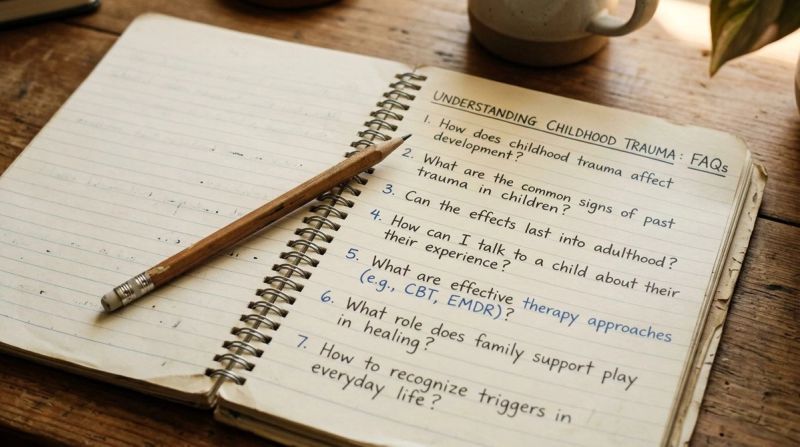
Frequently Asked Questions
Can childhood trauma affect you even if you had a "normal" childhood?
Yes. Trauma is subjective. What overwhelmed your nervous system as a child may not look dramatic from the outside. Emotional neglect, parental anxiety, or repeated criticism can have lasting effects even if there was no obvious abuse. If you are struggling now, your experience is worth taking seriously.
Do I have to remember everything to heal?
No. Healing does not require a complete or detailed memory. It requires a sense of safety, a supportive therapeutic relationship, and a willingness to understand how the past is affecting the present. Many people heal without ever recovering a clear narrative of what happened.
Is it too late to address childhood trauma as an adult?
No. The brain and nervous system remain capable of change throughout life. Many people begin trauma therapy in their thirties, forties, or later and find significant relief. It is never too late to develop new ways of relating to yourself and others.
Can childhood trauma cause physical health problems?
Yes. Research links childhood adversity to higher risks of conditions such as heart disease, autoimmune disorders, and chronic pain later in life. This is one reason why trauma-informed care addresses both mental and physical health, and why seeking support can benefit your whole body.
What if my family does not believe me?
This is painful and common. Healing does not depend on your family acknowledging what happened. It depends on finding people who do believe you, including a therapist, and learning to trust your own experience. Your reality matters, even if others cannot yet see it.
For a complete overview of trauma, PTSD, and recovery options in Ireland, see our complete guide to trauma therapy in Ireland. You may also find our guide to C-PTSD helpful.

You Can Heal, Even If It Started Long Ago
The child you were deserved safety, care, and consistency. If you did not get those things, it is understandable that adulthood still feels complicated. You may have spent years managing, pleasing, numbing, or performing your way through life. None of that makes you weak. It makes you resourceful.
But you do not have to keep surviving in the same way forever. With the right support, it is possible to feel safer in your body, kinder toward yourself, and more secure in your relationships. The past shaped you, but it does not have to define the rest of your life.
If you are ready to explore how childhood trauma is affecting your adult mental health, you can learn more about trauma therapy at Feel Better Therapy or get started here to find a therapist who fits you.
This article is for informational purposes only and does not constitute medical advice. If you are in crisis, please contact Samaritans Ireland at 116 123 or Pieta House at 1800 247 247.