Trauma Therapy in Ireland: A Complete Guide to PTSD, EMDR, and Recovery

A complete guide to trauma therapy in Ireland: what trauma and PTSD are, evidence-based treatments like EMDR, and how to find the right support.
Ciarán is 45 and lives in Belfast. Most days he manages fine. He works, sees friends, pays the bills. But every so often a sound, a smell, or a crowded street will throw him back to a night decades ago. His heart races, his mouth goes dry, and he feels like he is 19 again. He has known for years that something is wrong, but he only recently learned the word for it: PTSD.
He typed "trauma therapy Ireland" into his phone late one night and found dozens of options. Counsellors. Psychologists. EMDR. CBT. Online sessions. It felt overwhelming. What he wanted was a clear, honest guide that told him what trauma therapy actually involves, what works, and how to take the first step without being pushed.
If Ciarán's search sounds familiar, this guide is for you. Trauma is far more common than many people realise. A landmark study of the general population of the Republic of Ireland found that almost one in eight Irish adults met diagnostic requirements for PTSD or complex PTSD. In Northern Ireland, research from Queen's University Belfast and NICOLA found that nearly one in twenty people over 50 currently lives with PTSD, with the legacy of the Troubles a major contributing factor. These numbers are not just statistics. They represent neighbours, colleagues, family members, and maybe you.

What Trauma Actually Is
Trauma is not simply something bad that happened. It is the lasting impact an event — or series of events — has on a person's nervous system, emotions, body, and sense of safety. Two people can experience the same event and respond differently. What matters is how your brain and body processed what happened, not how it looks from the outside.
Trauma can follow a single incident such as an accident, assault, or sudden loss. It can also develop from repeated experiences such as childhood neglect, domestic abuse, bullying, or living through prolonged conflict. In Northern Ireland, for example, many people carry the effects of community violence and loss even decades later.
You can read more about the foundations of trauma in our article on what trauma actually is.
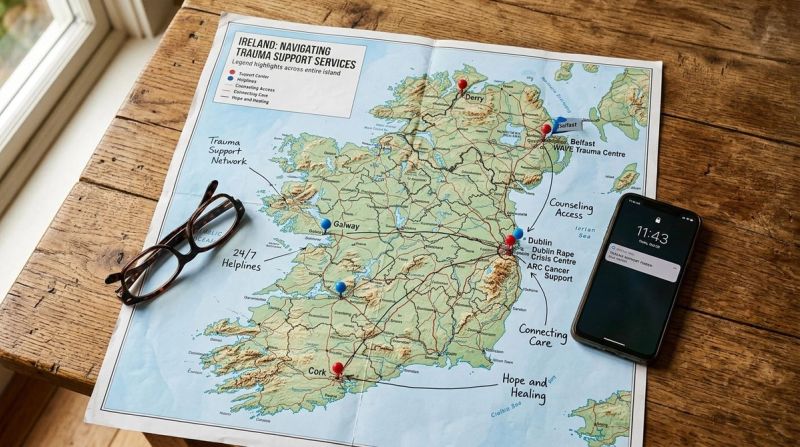
Trauma in the Irish Context
Trauma is not evenly distributed, and Ireland has its own particular history. In Northern Ireland, the legacy of the Troubles continues to affect mental health across generations. Research from Queen's University Belfast and the Northern Ireland Cohort for the Longitudinal Study of Ageing found that current PTSD rates among people over 50 are among the highest recorded in a population affected by conflict.
In the Republic of Ireland, the first general population study of trauma exposure, PTSD, and C-PTSD found that almost one in eight adults met diagnostic criteria. The study also highlighted a significant treatment gap, with many people experiencing symptoms but not accessing care.
Several factors affect access to trauma support in Ireland. Rural areas often have fewer specialists. Public services can be stretched. There is still stigma around seeking help for mental health, particularly in communities where talking about feelings has not always been encouraged. Online therapy has begun to bridge some of these gaps, allowing people to see specialists regardless of location.
Understanding this context matters because it reminds us that struggling with trauma in Ireland is not a personal failure. It is a public health issue with structural, historical, and social dimensions.

What Is PTSD?
Post-traumatic stress disorder, or PTSD, is a mental health condition that can develop after a person experiences or witnesses something traumatic. It is not a sign of weakness. It is the brain's way of trying to protect itself after an overwhelming threat.
The main symptoms of PTSD include:
- Re-experiencing the event through flashbacks, nightmares, or intrusive memories.
- Avoidance of reminders such as places, people, or conversations.
- Negative changes in mood and thinking, such as guilt, shame, or emotional numbness.
- Hyperarousal, including a heightened startle response, poor sleep, and difficulty relaxing.
For a fuller breakdown, see our guide to PTSD symptoms in adults. If you are having flashbacks or struggling with triggers, our practical article on flashbacks, nightmares, and triggers may also help.
Complex PTSD and Childhood Trauma
Not all trauma fits neatly into a single event. Complex PTSD, or C-PTSD, usually develops after repeated or prolonged trauma, often in childhood or within an abusive relationship. It includes the core symptoms of PTSD but also affects a person's self-image, relationships, and ability to regulate emotions.
Childhood trauma can be especially far-reaching because it shapes a developing brain. Adults who experienced neglect, abuse, or instability as children may notice patterns in relationships, self-worth, and emotional responses that trace back to those early years. This is not a character flaw. It is a survival adaptation that can, with the right support, become less dominant over time.
Learn more in our guides to C-PTSD and childhood trauma and adult mental health.

How Trauma Affects the Body and Relationships
Trauma is not only in the mind. It lives in the body too. Many people experience muscle tension, digestive problems, chronic pain, fatigue, or a persistent sense of being on edge. These are real physical symptoms with real causes. They are not imagined or exaggerated.
Relationships can also become complicated after trauma. Closeness may feel unsafe. Trust may be hard. Some people withdraw, while others find themselves repeating painful patterns. This happens because trauma can shape the way we learn to attach to others.
Our articles on trauma and the body and trauma and relationships explore these experiences in more depth.
"Recovery can take place only within the context of relationships; it cannot occur in isolation." — Dr. Judith Herman, psychiatrist and trauma researcher
That quote is worth remembering. Healing does not mean going it alone.

Evidence-Based Trauma Treatments Available in Ireland
Several therapies have strong evidence for helping people recover from trauma. The best choice depends on your situation, your preferences, and the type of trauma you have experienced. A therapist who is accredited with the IACP, IAHIP, PSI, or CORU can help you decide which approach is likely to suit you.
Trauma-Focused CBT
Cognitive behavioural therapy adapted for trauma helps you process what happened and change the patterns of thought and behaviour that keep you stuck. It is structured, practical, and widely available in Ireland. Trauma-focused CBT typically involves identifying unhelpful beliefs about the trauma, gradually facing reminders in a safe way, and developing coping skills. It is recommended by NICE and the HSE for PTSD.
EMDR
Eye Movement Desensitisation and Reprocessing, or EMDR, uses guided eye movements or other forms of bilateral stimulation to help the brain reprocess traumatic memories. The goal is not to erase the memory but to reduce its emotional intensity so it no longer triggers the same distress. EMDR is recommended by NICE and the HSE for PTSD and is available from trained therapists across Ireland. You can learn more in our EMDR therapy guide.
Somatic and Body-Based Therapies
These approaches focus on releasing trauma stored in the body. They can be especially helpful when talk therapy alone does not seem to shift the physical symptoms. Techniques may include grounding exercises, breath work, mindful movement, and tracking bodily sensations. Our article on trauma and the body explains how this works.
Psychodynamic and Humanistic Therapy
Some people benefit from longer-term exploratory therapy that looks at how past relationships and early experiences shape present difficulties. These approaches can be particularly helpful for complex trauma and childhood trauma, where the focus is often on building a secure therapeutic relationship over time.
Medication
Some people benefit from medication alongside therapy, particularly for severe depression, anxiety, or sleep disturbance. Antidepressants such as SSRIs are sometimes prescribed for PTSD. A GP or psychiatrist can discuss whether this is appropriate. Medication is usually most effective when combined with therapy rather than used on its own.
The HSE and professional bodies such as the IACP and IAHIP can help you find accredited therapists who offer these approaches.

How to Access Trauma Therapy in Ireland
There are several routes to trauma support in Ireland, depending on your circumstances, location, and budget. Many people use a combination of these options over time.
- HSE services. Your GP can refer you to HSE mental health services or community counselling. These services are free but often have waiting lists. In some areas, HSE-funded counselling is available for specific issues such as bereavement or sexual violence.
- Private therapy. You can contact a therapist directly. Fees typically range from €60 to €150 per session, depending on qualifications and location. Private health insurance may cover some costs. You do not usually need a GP referral to start private therapy.
- Online therapy. Services such as Feel Better Therapy match you with an accredited therapist and let you attend sessions from home. This can be especially helpful if you live in a rural area, have mobility issues, or find it hard to fit travel into your day. Our guide to starting trauma therapy online walks through the process.
- Voluntary organisations. Aware, Pieta House, Turn2Me, and similar organisations offer free or low-cost support, though availability varies. These services can be a valuable starting point, particularly while waiting for longer-term therapy.
For detailed information on costs and insurance, see our article on trauma therapy costs and insurance in Ireland.

Choosing the Right Therapist for You
Finding the right therapist can feel daunting, but a few practical questions can make the process easier:
- Are they accredited with a recognised body such as the IACP, IAHIP, PSI, or CORU?
- Do they have specific experience working with trauma, and with your type of trauma?
- Which approaches do they use, and do those fit what you are looking for?
- Do they offer online or in-person sessions, and does that suit your life?
- Do you feel comfortable talking to them? Fit matters as much as credentials.
It is normal to speak to more than one therapist before choosing. Most will offer a brief consultation so you can get a sense of whether they are the right person to support you.

What to Expect From Trauma Therapy
Trauma therapy is not about being forced to talk before you are ready. A good therapist will help you feel safe first. They will explain how they work, what to expect, and how you can slow things down if emotions become too intense.
Therapy usually involves:
- Building trust and safety.
- Understanding how trauma has affected you.
- Learning skills to manage symptoms.
- Processing traumatic memories at a pace that feels manageable.
- Reconnecting with your values, relationships, and sense of future.
Progress is rarely linear. Some weeks will feel easier than others. That is normal. The important thing is that you are no longer facing it alone.

How to Support Someone Living With Trauma
If someone you care about is struggling, the most helpful thing you can offer is steady, non-judgemental presence. You do not need to fix them. You do not need to have the right words. Often, simply listening and believing them is enough.
Avoid pressuring them to talk about details they are not ready to share. Encourage them to seek professional help, but respect their timing. Let them know you are there, and follow their lead. Small, consistent gestures — a text, a walk, a cup of tea — can matter more than grand interventions.

What If You're Not Ready for Therapy?
Not everyone is ready to start therapy right away, and that is okay. There are still things you can do to support yourself while you consider your options.
Grounding techniques, such as naming five things you can see or feeling your feet on the floor, can help when you feel overwhelmed. Regular sleep, movement, and time in nature can support your nervous system. Reading about trauma — including the articles linked throughout this guide — can help you feel less alone and more informed.
If you do decide to try therapy later, that decision is still valid. There is no deadline for seeking help.

Frequently Asked Questions
How common is PTSD in Ireland?
Research suggests that almost one in eight adults in the Republic of Ireland meets diagnostic criteria for PTSD or C-PTSD. In Northern Ireland, nearly one in twenty people over 50 currently lives with PTSD, with the Troubles a significant contributing factor. These figures likely underestimate the true picture, as many people never seek a diagnosis.
What is the most effective trauma therapy?
There is no single best therapy for everyone. Trauma-focused CBT and EMDR both have strong evidence for PTSD. Somatic therapy can help when trauma is held in the body. Psychodynamic or humanistic approaches may suit people with complex trauma or childhood trauma. The right approach depends on the person, the trauma, and the therapeutic relationship.
Can trauma therapy be done online?
Yes. Many accredited therapists in Ireland offer online sessions, and research shows it can be just as effective as in-person therapy for many people. It also removes barriers such as travel, time off work, and location. Our guide to starting trauma therapy online explains what to expect.
How do I know if I need trauma therapy?
If past experiences are affecting your sleep, relationships, mood, work, or sense of safety, it may be worth speaking to a therapist. Common signs include flashbacks, nightmares, avoiding reminders, feeling numb, being easily startled, and struggling to trust people. You do not need a formal diagnosis to benefit from support.
How long does trauma therapy take?
It varies. Some people notice meaningful change within a few months. Others continue for longer, especially if the trauma was complex or began in childhood. A good therapist will discuss this with you, set goals, and check in regularly about progress. There is no fixed timeline for healing.

Recovery Is Possible
Trauma can make the world feel smaller, less safe, and less hopeful. It can convince you that things will never change. But the evidence — and the experience of thousands of people in Ireland — says otherwise.
Recovery does not mean forgetting what happened. It means the memory no longer controls your daily life. It means being able to sleep, trust, work, love, and rest without the past constantly pulling you back.
Whether you are just beginning to recognise the effects of trauma or you have been searching for the right help for a while, the next step does not have to be dramatic. It just has to be a step.
At Feel Better Therapy, we help people across Ireland get matched with a therapist who understands trauma. You can learn more about our trauma therapy service or get started here.
This article is for informational purposes only and does not constitute medical advice. If you are in crisis, please contact Samaritans Ireland at 116 123 or Pieta House at 1800 247 247.