Flashbacks, Nightmares, and Triggers: A Practical Guide

A practical Irish guide to understanding flashbacks, nightmares, and trauma triggers, with tools you can use and when to seek therapy support.
Mark is 31 and lives in Cork. Most evenings he drives home along the same road without thinking much about it. But last Tuesday, a lorry overtook him and the smell of diesel filled the car. In an instant he was somewhere else. His hands were shaking. His heart was pounding. He could hear a voice he had not heard in years.
It took nearly half an hour before he felt fully present again. He sat in his driveway, embarrassed and exhausted, wondering what was wrong with him. That night he dreamed about it again. He woke up sweating, convinced for a few confused seconds that he was back there.
Mark did not tell anyone at first. He thought other people would think he was overreacting. But the truth is, his nervous system was doing exactly what it had learned to do. It was trying to keep him safe.
If Mark's story feels familiar, you are far from alone. Flashbacks, nightmares, and triggers are some of the most distressing symptoms of trauma. Research from Northern Ireland has found that around 4.7% of adults over 50 currently live with PTSD, with many reporting that their worst experiences are related to the Troubles. Flashbacks and nightmares are core features of PTSD and complex PTSD. They are not signs of weakness. They are signs that the nervous system is still trying to process something overwhelming.

What Flashbacks Actually Are (and Are Not)
A flashback is not just a vivid memory. It is a feeling that the traumatic event is happening again, right now. Sights, sounds, smells, or even bodily sensations can pull a person out of the present and into the past. Time becomes distorted. The body reacts as if the danger is immediate.
Flashbacks can range from mild to intense. Some people experience them as intrusive images or thoughts. Others feel completely transported. They can last seconds or hours. They can be triggered by something obvious, like a news report, or something subtle, like a particular tone of voice or a smell.
It is important to know what flashbacks are not. They are not attention-seeking. They are not exaggeration. They are not a sign that you are going crazy. They are a nervous system response to unprocessed trauma. Understanding this can reduce some of the shame that often comes with them.
"Flashbacks are re-experiencing the event as if it were happening now." — Dr. Bessel van der Kolk, psychiatrist and trauma researcher
That sentence captures why flashbacks feel so real. The brain's alarm system is firing as though the original threat is still present. The thinking brain knows it is not. The survival brain is not so sure.

Why Triggers Feel So Powerful
A trigger is anything that reminds the nervous system of the original trauma. It can be external, like a place, a sound, a smell, or a date. It can also be internal, like a particular feeling, a bodily sensation, or even a thought pattern.
Triggers are powerful because they bypass rational thinking. The amygdala, the brain's smoke alarm, reacts before the prefrontal cortex has time to assess the situation. This is why you can be perfectly safe and still feel terrified. Your body is preparing you to survive something that happened long ago.
Over time, triggers can start to narrow a person's life. Someone might avoid driving, crowded places, certain people, or even particular types of music. Avoidance makes sense in the short term, but it can also reinforce the idea that the world is dangerous. Part of healing is learning, little by little, that safety is possible even when a trigger appears.

What Nightmares Can Tell You
Nightmares are another way the brain tries to process trauma. During sleep, the mind moves through memories, emotions, and unresolved experiences. For someone with trauma, this process can become frightening. Nightmares may replay the event directly, or they may take on symbolic forms: being chased, trapped, unable to scream, or watching something terrible happen to someone you love.
Nightmares can also affect sleep quality in ways that build up over time. Poor sleep makes the nervous system more reactive, which can increase flashbacks and emotional flooding during the day. It becomes a cycle. Breaking it usually requires addressing the underlying trauma, not just the sleep itself.
It is worth mentioning that nightmares are not always about trauma. But when they are recurrent, distressing, and tied to a past experience, they deserve attention.

Practical Tools for the Moment
You cannot talk yourself out of a flashback while you are in one. The thinking brain is offline. What helps is grounding. Grounding techniques bring attention back to the present moment and signal to the nervous system that the danger has passed.
Here are some practical tools:
- Name five things you can see. Then four you can touch, three you can hear, two you can smell, and one you can taste. This classic grounding exercise engages the senses and brings attention back to now.
- Press your feet into the floor. Feel the weight of your body in the chair. Notice the texture of your clothes against your skin.
- Hold something cold or warm. A glass of water, a cool stone, or a warm mug can anchor you in the present.
- Breathe slowly. Inhale for four counts, hold for four, exhale for six. Longer exhales activate the calming branch of the nervous system.
- Remind yourself of the date and place. Say it out loud if you can. "I am in Ireland. It is 2026. I am safe right now."
These tools are not cures. They are first aid. They can help you ride the wave until the intensity passes. Over time, with the right support, the waves usually get smaller.
It can also help to make a simple plan for yourself while you are calm. Write down two or three grounding techniques that have worked for you before. Note a person you can text or call. Keep the list somewhere easy to reach. When a flashback hits, decision-making is harder, so having a plan ready can make a real difference.

When to Seek Professional Help
Grounding tools are useful, but they are not a replacement for therapy. If flashbacks, nightmares, or triggers are interfering with your daily life, it is worth reaching out for professional support. That might mean talking to your GP, contacting a therapist directly, or using an online service.
Therapies that are recommended for trauma symptoms in Ireland include:
- Trauma-focused CBT
- EMDR
- Somatic therapy and body-based approaches
- Medication, in some cases, prescribed by a doctor
The HSE and NICE guidelines both recognise trauma-focused CBT and EMDR as effective treatments for PTSD. You can read more about what trauma actually is, PTSD symptoms, or EMDR in Ireland on our blog.
If you are having thoughts of harming yourself, contact your GP, go to your nearest emergency department, or reach out to Samaritans Ireland at 116 123.
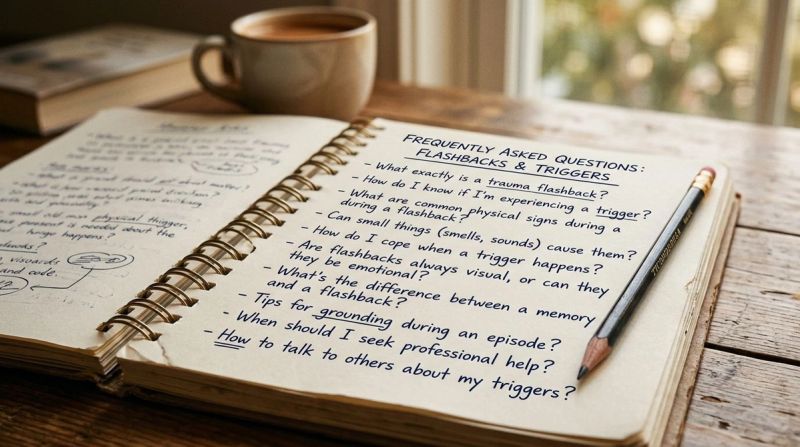
Frequently Asked Questions
Are flashbacks the same as bad memories?
No. A bad memory is something you can recall while knowing it is in the past. A flashback feels as though the event is happening again. The distinction matters because flashbacks involve the body's survival response, not just the mind.
Can nightmares cause trauma?
Nightmares do not usually cause trauma on their own, but traumatic nightmares can keep the nervous system activated and make daytime symptoms worse. Treating the underlying trauma often improves sleep over time.
Why do triggers seem to come out of nowhere?
Triggers can be subtle. A smell, a sound, a feeling in the body, or even a facial expression can remind the nervous system of the original event without the conscious mind making the connection. This is normal, even if it feels confusing.
How do I explain flashbacks to someone who has not had them?
You might say, "It feels like the past is happening right now, even though I know it is not. My body reacts before my mind can catch up." You do not owe anyone a detailed explanation, but having a simple phrase ready can help.
Can flashbacks go away on their own?
Sometimes they lessen over time, especially if life feels safe and stable. But many people find they do not fully disappear without support. Therapy can help the brain process the trauma so flashbacks become less frequent and less intense.
For a complete overview of trauma, PTSD, and recovery options in Ireland, see our complete guide to trauma therapy in Ireland. You may also find our guide to PTSD symptoms in adults helpful.

You Are Not Back There
Living with flashbacks, nightmares, and triggers can make the world feel unpredictable. One moment you are fine, and the next you are pulled under. It is exhausting. It is frightening. And it is not your fault.
The goal of healing is not to erase the memory. It is to change your relationship with it. To help your body learn that the danger has passed. To widen your life again so that triggers lose some of their power.
You do not have to do this alone. At Feel Better Therapy, we can match you with a therapist who understands trauma and its aftermath. You can learn more about trauma therapy or get started here to find someone who fits you.
This article is for informational purposes only and does not constitute medical advice. If you are in crisis, please contact Samaritans Ireland at 116 123 or Pieta House at 1800 247 247.