Men's Mental Health in Ireland: Why the Silence Isn't Personal

Men in Ireland die by suicide at four times the rate of women and use therapy far less. What the figures say, why the silence is learned, and the routes that work.
You know a man who isn't doing well. He might be you.
He's working, he's answering messages, he's at the match, he's grand. And every so often something slips — a joke that lands a bit too hard, a week where he doesn't reply, a pint that turns into six.
Nothing about that is unusual in Ireland. Which is the problem.
What the Numbers Actually Say
Start with the figures, because they're stark and they're Irish and they don't get quoted often enough.
The Central Statistics Office recorded 481 deaths from suicide in 2024 — 387 of them male, 94 female. Deaths from accidents, suicide and other external causes accounted for 1,875 deaths that year, of which 1,245 were male and 630 female.
That's roughly four in every five suicide deaths being men, in a country of five million people.
Then there's the other side of the ledger: how rarely men use the services that exist. Men are consistently less likely than women to attend a GP with a mental health concern, less likely to be referred to counselling, and less likely to stay in therapy once they start.
So the picture isn't that men don't suffer. It's that men suffer the same conditions and arrive at help much later, or not at all.
Why Men Don't Walk In
The most useful research on this isn't about men being stubborn. It's about what men have been taught.
A systematic review of 47 studies found that traditional masculinity norms centred on strength, self-reliance and emotional stoicism significantly deter men from seeking mental health support — both by affecting their mental health directly and by putting barriers in front of help-seeking.
Lewis King, a lecturer and researcher at the Technological University of the Shannon who studies men's experiences of loss, has put the same finding in plain terms in the Irish Examiner: "Our research found that stigma, masculinity, and self-reliance can become barriers to men seeking help."
Note what that doesn't say. It doesn't say men are bad at feelings, or that men need to be fixed, or that masculinity is the problem. It says a set of learned rules creates a barrier, and barriers can be worked around.
King also names the trap that opens up when people push too hard: "Emotional expression should not become another standard that men feel they are failing to meet."
That's worth sitting with. Telling a man he should open up, in a tone that implies he's currently failing, adds a new way to lose.
The Irish Policy Nobody Mentions
Here's something that would surprise most men in the country: Ireland was the first country in the world to publish a national men's health policy, back in 2008.
The current one is the National Men's Health Action Plan — Healthy Ireland – Men (HI-M) 2024–2028, published in November 2024 and launched by the HSE on 18 November 2024. Funding was secured in the 2025 Estimates for a National Lead for Men's Health in the HSE.
The Department of Health's own language on why it exists: "There continues to be significant differences in health outcomes not just between men and women, but between different population groups of men… the health needs of men, in particular marginalised and disadvantaged men, require a gender specific approach."
Read that again for what it concedes. It's not just that men die younger and use services less. It's that the worst outcomes collect among men with the least money, the least security and the fewest options.
So if you've ever felt that the mental health system wasn't built with you in mind, the State's own policy documents agree with you.
What the Silence Actually Costs
The cost shows up in places people don't connect to mental health.
Work. Men often keep going until something breaks — the sick leave that comes after a collapse rather than before it.
Drink. Alcohol is the most socially acceptable anaesthetic in Ireland and the most common way men manage anxiety, insomnia and grief without naming any of them.
Anger. Irritability is often what depression looks like in men. The short fuse at home, the shouting in traffic, the sudden rage about a dishwasher — frequently the surface of something heavier.
Relationships. Withdrawal reads as indifference to a partner who is watching it happen. Many men describe losing a relationship before they understood they'd been depressed.
Body. Muscle, weight, and food become areas where distress gets expressed when there's no other outlet. Men are diagnosed with eating disorders far less often than women despite experiencing them.
And loneliness. The clearest Irish evidence comes from the Irish Men's Sheds Association's Sheds for Life programme: a study of 421 men across 22 sheds found loneliness among members rose from 1.4% before the sheds closed during COVID-19 to 39.2% a year later. When the place where men met disappeared, the loneliness arrived immediately.
That last figure tells you something important: men's connection in Ireland often runs through a place and an activity, not through conversations. Remove the place and there's nothing holding it.
The Routes That Actually Work
This is the part that rarely gets said: men do use support. They just use it in forms that don't look like the brochure.
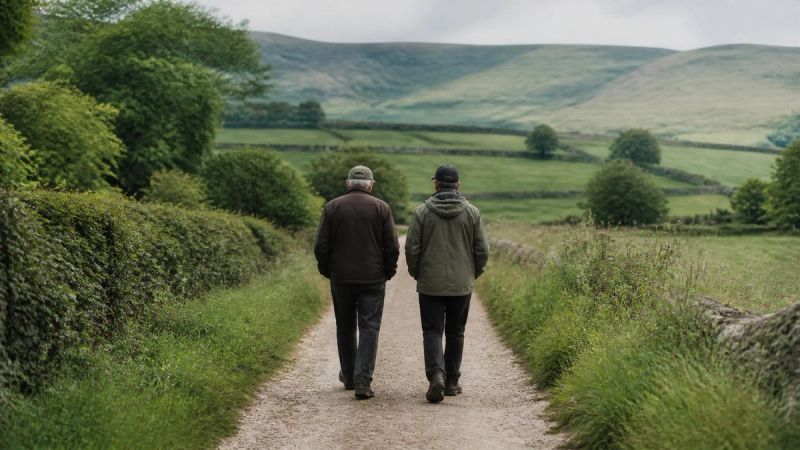
Side by side, not face to face. Walking, driving, fixing something, watching a match — conversations happen at an angle and last longer that way.
Through a place. Men's Sheds, clubs, five-a-sides, hillwalking groups, choirs, volunteer crews. The Sheds research describes this as "health by stealth": the wellbeing arrives through the activity, so nobody has to identify as a patient or a help-seeker to get it.
By text. A message is easier than a phone call for a lot of men, and replying to a text doesn't require the same performance of being fine.
Through the GP, framed practically. "I'm not sleeping and I'm not right" works. You don't have to have the language for it.
Through work. Employee assistance programmes exist in most larger employers and are confidential. Most men who use them never mention it to a colleague.
Through therapy, done differently. A good therapist will work with a man who doesn't want to emote on cue. It doesn't have to be an hour of feelings; often it starts with what's going wrong and works backwards.
Our guide to depression in men and why Irish men struggle to seek help covers the presentation in more depth, including the way it hides.

What to Say to a Man You're Worried About
Keep it concrete and keep it short. Vague invitations ("if you ever need anything") are easy to decline.
Try: "You've not seemed yourself for a few weeks. I'm not going to make a thing of it, I just wanted to say it." Then ask again a week later. Being asked twice is often what makes the difference, because the first ask can be deflected by reflex.
Don't lead with advice, statistics or a diagnosis. Don't say "you need to talk to someone" as an instruction — offer a specific thing: a walk, a lift to the GP, a pint where you don't mention it but you do show up.
If you're worried he's in danger, say so directly and stay with him. Asking a man whether he's having thoughts of suicide doesn't plant the idea; it opens a door that was already there.
If You're the Man Reading This
You don't need to have it worked out before you do anything about it.
The most common thing men say afterwards is that they wish they'd gone sooner, and that the first appointment was nothing like they'd feared — a few questions, no interrogation, no requirement to cry.
If you're not sleeping, if you're drinking more than you meant to, if you're angry in a way that's new, or if you're getting nothing out of anything, that's enough reason to see a GP. You don't need to be at breaking point to qualify.
And if you don't want to talk about it yet, that's allowed. Text someone instead. Go to the shed. Book the appointment and decide what to say on the way. The order doesn't matter as much as starting somewhere.
If you'd like to do this without a waiting list or a referral, you can get matched with a therapist and take it from there.

If You Need Help Today
Samaritans — 116 123, free, 24 hours a day, every day. Text About It — 50808, free, 24-hour text support. Pieta — 1800 247 247, free, 24 hours. Emergency — 112 or 999, or your nearest emergency department.
You don't need the right words to ring any of them. "I'm not okay" is a complete sentence and it's enough to start the call.
Frequently Asked Questions
Why are men less likely to go to therapy?
Research points to learned norms around strength, self-reliance and emotional stoicism, which create practical and psychological barriers to asking for help. It isn't about men not feeling things.
Do men grieve differently?
Often, yes — grief in men frequently shows up as activity, problem-solving, work or silence rather than talking. It's still grief, and it still needs somewhere to go.
What if I don't want to talk about my feelings?
You don't have to start there. Most therapy starts with what's actually going wrong — sleep, work, a relationship, anger — and works backwards. Side-by-side settings like Men's Sheds work for the same reason.
Is it worth going to the GP if I'm not sure it's depression?
Yes. "I'm not sleeping and I'm not right" is a legitimate reason to go, and a GP can work out what's next.
Related Articles
- Anger Management for Men in Ireland
- Eating Disorders in Men
- The Partner's Grief: When You're Expected to Be Fine
This article is for informational and emotional support only and does not constitute medical advice. If you are in crisis or having thoughts of suicide, contact Samaritans on 116 123 (free, 24/7), Text About It on 50808 (free, 24/7) or Pieta on 1800 247 247 (free, 24/7), or use 112 or 999 or attend your nearest emergency department.