Agoraphobia in Ireland: When Fear Keeps You Inside

Learn what agoraphobia is, how it shows up in Ireland, and how CBT and exposure therapy can help you regain your freedom.
Ciarán is 31 and lives in a second-floor flat in Cork city. Until six months ago, he took the bus to work, met friends for pints on a Friday, and walked along the Lee at the weekend. Then, one Tuesday morning on a crowded 208, his heart began to race. The walls of the bus seemed to press in, his hands went numb, and he was convinced he was about to faint in front of everyone. He got off at the next stop, sat on a bench for twenty minutes, and called a taxi home.
That was the last time Ciarán used public transport. Within weeks, he started avoiding supermarkets, queues, and anywhere he thought he might feel trapped. Now he shops online, declines invitations, and only leaves the flat for GP appointments — and even those feel like an expedition. He tells himself he is being sensible. His family says he has become "a bit of a hermit." Neither explanation feels right.
If Ciarán's story sounds familiar, you're not alone — and you're not simply lazy, awkward, or antisocial. You may be experiencing agoraphobia, a treatable anxiety disorder that affects more people in Ireland than most of us realise.

What Agoraphobia Actually Is
Agoraphobia is often misunderstood as a fear of open spaces. In reality, it is a fear of situations where escape might be difficult, help might be unavailable, or panic symptoms could feel embarrassing or dangerous. Crowded shops, public transport, bridges, motorways, queues, and even leaving the house alone can become overwhelming.
The condition usually develops after someone has one or more panic attacks. Once the brain learns to associate a particular place with intense fear, avoidance becomes a way of preventing another attack. Over time, the list of "unsafe" places grows, and the person's world shrinks.
"Agoraphobia is not a fear of spaces themselves. It is a fear of what might happen to you in those spaces, and the belief that you will not be able to cope." — Dr. Aaron T. Beck, founder of cognitive behavioural therapy
Anxiety disorders, including phobias, affect roughly one in ten Irish adults at some point in their lives, according to HSE guidance on mental health. Agoraphobia is less talked about than generalised anxiety or depression, which means many people suffer for years before recognising it as a clinical condition.
It is also more common in women and often begins in late adolescence or early adulthood, although it can develop at any age. The good news is that agoraphobia responds very well to structured psychological treatment, particularly cognitive behavioural therapy (CBT).

What Agoraphobia Looks Like in Daily Life
Agoraphobia does not always look like someone refusing to leave their home. For many people, it is more subtle: taking the long way around to avoid a bridge, only shopping at quiet times, or needing a trusted person to accompany them everywhere.
Common signs include:
- Avoiding public transport, especially buses, trains, or the Luas during rush hour
- Feeling unable to queue in supermarkets, post offices, or banks
- Driving only on familiar routes and avoiding motorways or dual carriageways
- Leaving events early or cancelling plans to stay within a "safe zone"
- Feeling dizzy, breathless, nauseous, or disconnected in crowded places
- Relying heavily on a partner, parent, or friend to go out with you
The physical sensations can be intense: a racing heart, chest tightness, sweating, trembling, and a powerful urge to flee. These symptoms are part of the body's natural fight-or-flight response, but in agoraphobia they are triggered by situations that are objectively safe.
What keeps the cycle going is avoidance. Every time you leave a shop early, take a taxi instead of the bus, or stay home, your brain gets the message that those situations really are dangerous. The safety behaviour feels protective in the moment, but it reinforces the fear over time.

What Causes Agoraphobia?
There is rarely a single cause. Agoraphobia tends to develop from a combination of factors.
Panic attacks as a trigger. Many people with agoraphobia first experience a panic attack in a public place. The memory of that attack becomes linked to the location, and avoidance spreads from there.
Genetic and biological factors. Anxiety disorders can run in families. Some people are naturally more prone to a sensitive stress response, which makes panic more likely.
Life stress and transitions. Bereavement, redundancy, relationship breakdown, illness, or the demands of caring for someone can lower our resilience and make anxiety harder to manage.
Cultural pressures. In Ireland, where resilience and "getting on with it" are often praised, admitting to fear can feel like failure. Many people hide their avoidance for years, which delays treatment and deepens isolation.
Safety behaviours. Avoidance, carrying water, sitting near exits, or always having a phone charged are understandable coping strategies. But they can maintain the problem by preventing the brain from learning that the feared situation is survivable.
How Agoraphobia Is Treated in Ireland
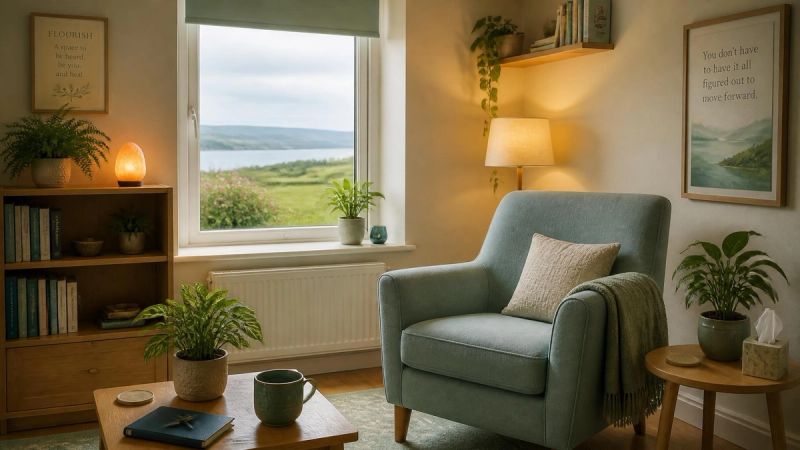
Agoraphobia is one of the most treatable anxiety disorders. The evidence-based approaches recommended by the HSE and NICE include CBT, exposure therapy, and, in some cases, medication.
Cognitive behavioural therapy (CBT). CBT helps you identify the thoughts that fuel your fear — such as "I'll faint on the bus" or "I'll lose control in the queue" — and test whether those predictions are accurate. A therapist works with you to build a graded plan, starting with small steps and increasing difficulty as your confidence grows.
Exposure therapy. This is the behavioural part of CBT. Instead of jumping into your worst fear, you approach it gradually. You might start by standing near the front door, then walking to the corner shop, then taking a one-stop bus journey. Each success teaches the brain that the feared outcome does not happen, and that even mild anxiety will peak and pass.
Medication. Selective serotonin reuptake inhibitors (SSRIs) can help reduce the intensity of anxiety and panic, which makes exposure work easier. A GP or psychiatrist can advise whether medication is appropriate alongside therapy.
Online therapy. For people whose agoraphobia makes in-person appointments difficult, online CBT can be an effective starting point. It allows you to begin treatment from a familiar environment and build towards facing the outside world.
In Ireland, you can access psychological support through your GP, HSE mental health services, or a private accredited therapist. The IACP and PSI maintain registers of qualified professionals. Waiting lists for public services can be long, so many people choose private therapy to begin sooner.
What You Can Do If You Think You Have Agoraphobia
Recognising the problem is the hardest step. If you see yourself in Ciarán's story, here are practical ways to begin.
Name it accurately. Agoraphobia is a recognised anxiety disorder, not a personality flaw. Calling it by its proper name can reduce shame and open the door to proper help.
Start small and repeat. Choose one avoided situation that feels manageable — perhaps walking to the end of your road — and do it repeatedly until it becomes boring. Avoidance shrinks your world; repetition expands it.
Resist the urge to flee. When anxiety rises, your instinct will be to escape. If you can, stay in the situation until your anxiety begins to come down naturally. This is how the brain learns that panic does not last forever.
Reduce safety behaviours gradually. Notice the things you do to feel safe, such as gripping the shopping trolley tightly or checking for exits. Slowly scale them back so your brain discovers it can cope without them.
Talk to someone. Tell a trusted friend, family member, or GP what you are experiencing. Secrecy feeds shame; connection weakens it.
Consider professional support. CBT for agoraphobia is structured, practical, and effective. A therapist can guide your exposure plan, keep you from moving too fast or too slow, and help when progress stalls.

Frequently Asked Questions
What is the difference between agoraphobia and social anxiety?
Agoraphobia is a fear of situations where escape or help might be difficult, often because of panic symptoms. Social anxiety is a fear of being judged or embarrassed by other people. Someone can have both, but the focus of the fear is different.
Can agoraphobia go away on its own?
Sometimes symptoms improve without treatment, but they often return under stress. Avoidance can make the condition more entrenched over time. Structured therapy is the most reliable way to recover and stay well.
How long does CBT for agoraphobia take?
Many people see meaningful improvement within 8 to 16 sessions, though this varies. The key is consistent practice between sessions. Progress depends more on what you do outside the therapy room than inside it.
Is agoraphobia common in Ireland?
Anxiety disorders, including phobias, are among the most common mental health conditions in Ireland. Exact figures for agoraphobia alone are not routinely published, but HSE mental health resources consistently identify anxiety and panic as significant issues for Irish adults.
Related Articles
Agoraphobia can make the world feel small, but it does not have to stay that way. With the right support, the places you have avoided can gradually become ordinary again. Recovery is not about becoming fearless — it is about learning that fear does not have to make your decisions for you.
If you are struggling, you do not have to figure it out alone. CBT and exposure therapy are proven ways to reclaim the ground agoraphobia has taken. At Feel Better Therapy, you can get matched with a therapist who understands anxiety disorders and can work with you at a pace that feels manageable. You might also find it helpful to read about anxiety therapy and CBT to see what support is available.
This article is for informational purposes only and does not constitute medical advice. If you are in crisis, please contact Samaritans Ireland at 116 123 or Pieta House at 1800 247 247.