Emotionally Focused Therapy (EFT) Online: Reconnecting with Your Partner

Feeling like roommates instead of partners? Discover how online Emotionally Focused Therapy (EFT) in Ireland helps couples break negative cycles and rebuild a deep, secure emotional bond from home.
In the quiet, agonizing space of a struggling relationship, the most profound pain rarely stems from the logistics of daily life. It does not come from disagreements over how to load the dishwasher, whose turn it is to walk the dog, or how to manage the monthly household budget. The deepest, most corrosive pain arises from a terrifying sense of emotional disconnection. It is the chilling realization that the person sleeping next to you feels millions of miles away. You may find yourselves living as polite roommates, tiptoeing around one another to avoid triggering yet another exhausting, circular argument that never seems to resolve anything. In these moments of profound marital distress, couples in Ireland are increasingly seeking a specific, highly effective form of intervention: Emotionally Focused Therapy (EFT). Recognized globally as the gold standard for relationship repair, EFT operates on the fundamental premise that at the core of every argument is a desperate, often poorly expressed plea for emotional connection and secure attachment.
Historically, accessing certified EFT specialists required living in major urban centres and committing to weekly commutes to a clinical office. Today, the landscape of psychological support has radically transformed. Online Emotionally Focused Therapy is providing couples across the entire country with unprecedented access to this life-changing modality. By participating in these deeply vulnerable sessions from the psychological safety of their own living rooms, partners are finding that the virtual environment actually accelerates the process of breaking destructive cycles and rebuilding a secure, loving bond. This comprehensive guide will explore the fascinating science of adult attachment, decode the negative "dance" that traps so many couples, and explain exactly how an online EFT therapist will help you and your partner find your way back to one another.

The Science of Connection: Understanding Adult Attachment Theory
To truly grasp why Emotionally Focused Therapy is so exceptionally effective, we must first look at the psychological foundation upon which it is built: Attachment Theory. Originally developed by British psychoanalyst John Bowlby in the mid-20th century to explain the intense distress infants experience when separated from their mothers, Attachment Theory was later brilliantly adapted to adult romantic relationships by Dr. Sue Johnson, the primary developer of EFT. The core premise is both simple and profoundly paradigm-shifting: human beings are hardwired for connection from the cradle to the grave. We do not outgrow the need for a safe haven and a secure base.
In adult relationships, our romantic partner essentially becomes our primary attachment figure. They are the person we look to for comfort, safety, and emotional regulation in a chaotic, unpredictable world. When this primary attachment bond is secure, we feel confident, resilient, and capable of exploring the world and taking risks. We know that if we fall, our partner will be there to catch us. However, when this vital bond is threatened—by perceived rejection, coldness, harsh criticism, or emotional withdrawal—our primitive brain perceives it as a literal threat to our survival. We are plunged into a state of "primal panic."
"Underneath all the angry arguments about finances, in-laws, or household chores, there is always one fundamental, underlying question being asked: 'Are you there for me? Do I matter to you? If I reach out, will you respond?' When the answer feels like a 'no,' the resulting panic triggers the destructive coping mechanisms that tear relationships apart."
Every fight you have with your partner is essentially an echo of this primal panic. When couples understand that their intense, frightening arguments are not actually signs that they hate each other, but rather misguided, desperate protests against the loss of their emotional connection, a profound shift in perspective occurs. It moves the relationship away from a courtroom battle of right and wrong, and transforms it into a shared mission to restore safety.
The Negative Dance: Pursuers and Withdrawers
When the attachment bond is threatened and primal panic sets in, individuals generally adopt one of two primary survival strategies to manage their overwhelming anxiety. In EFT, these strategies are often categorized as "pursuing" or "withdrawing." Understanding these roles is the critical first step in an online therapy session. Over time, these two opposing strategies lock together to form a rigid, highly destructive negative cycle—what EFT therapists often refer to as the "demon dialogue" or the "negative dance."
The Pursuing Partner
The pursuing partner manages their attachment anxiety by aggressively trying to close the emotional distance. When they feel their partner pulling away, they panic. They may become highly critical, demanding, angry, or relentlessly questioning. They will often follow their partner from room to room to force a resolution. To the outside observer, they look controlling or perpetually dissatisfied. However, beneath the harsh, critical exterior, the pursuer is usually experiencing profound feelings of abandonment, unimportance, and terrifying isolation. Their anger is merely a tragic, ineffective cry for connection.
The Withdrawing Partner
The withdrawing partner manages their attachment anxiety by attempting to shut down the conflict and protect the relationship from further damage. When faced with the intense, critical energy of the pursuer, the withdrawer feels entirely inadequate, overwhelmed, and fundamentally flawed. To survive this emotional flooding, they shut down. They become silent, avoid eye contact, intellectualize the problem, or physically leave the room. To the pursuer, this looks like cold, cruel indifference. However, beneath the stony exterior, the withdrawer is usually experiencing deep feelings of failure, rejection, and a paralyzing fear of making things worse.
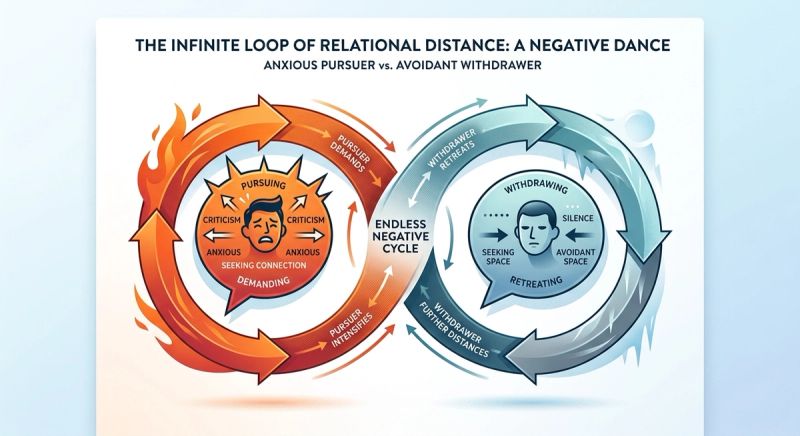
The tragedy of this dynamic is that the cycle is entirely self-perpetuating. The more the pursuer aggressively demands connection (looking like anger), the more the withdrawer shuts down to protect themselves. The more the withdrawer shuts down (looking like abandonment), the more panicked and aggressive the pursuer becomes. They are caught in a relentless loop. In online EFT, the therapist will help you realize that your partner is not the enemy. The cycle itself is the enemy. If you find yourselves trapped in a pattern of endless, repetitive arguments, you may want to read our foundational guide on Breaking the Cycle: How Online Therapy Helps Irish Couples Improve Communication to understand how virtual mediation actively halts this dynamic.
Why EFT Thrives in the Online Virtual Environment
Because Emotionally Focused Therapy involves accessing deep, vulnerable, and often painful primary emotions, couples frequently wonder if this intense level of psychological work can genuinely be achieved through a computer screen. The clinical reality is that the virtual format is not merely an adequate substitute for in-person EFT; for many couples, it actively enhances and accelerates the therapeutic process.
The primary goal of the initial stages of EFT is de-escalation—lowering the emotional temperature so that rational, empathetic thought can return. When a couple attends a physical clinic, they are sitting in an unfamiliar room, often just inches away from the partner who triggers their deepest anxieties. This physical proximity can maintain a state of hyperarousal, making it incredibly difficult for a withdrawing partner to find their voice, or for a pursuing partner to soften their defensive anger.

Engaging in online EFT from the comfort of your own living room alters this dynamic entirely. The home environment provides a crucial baseline of psychological safety. The slight, artificial distance provided by the digital screen acts as a powerful, regulating buffer. It allows both partners to engage in terrifyingly vulnerable conversations—such as admitting to feelings of deep inadequacy or profound loneliness—without feeling physically cornered, intimidated, or overwhelmed by the immediate proximity of the other person.
Furthermore, conducting this deep emotional work in the very environment where the couple lives and breathes ensures that the breakthroughs are contextually anchored. They are learning to turn toward each other and express soft, primary emotions while sitting on their own sofa, making it significantly easier to replicate that healthy behaviour on a Tuesday evening when the therapist is no longer present.
The Three Stages of Emotionally Focused Therapy
Online EFT is not a generic, unstructured process where the therapist simply acts as a passive sounding board. It is a highly structured, scientifically validated roadmap consisting of three distinct stages. Your online therapist will act as an active, engaged guide, holding your hands as you navigate through this complex terrain.
Stage 1: De-escalation of the Negative Cycle
The first phase is entirely focused on stopping the bleeding. The online therapist will work with you to meticulously map out your specific negative cycle. They will help you identify the triggers, the reactive behaviours (pursuing or withdrawing), and the hidden, primary emotions driving those behaviours. The goal of this stage is for both partners to step back, look at the cycle, and realize, "We are both trapped in this terrible dance, and we are both hurting." Once the cycle is externalized as the mutual enemy, the intense blame and hostility begin to naturally dissipate.
Stage 2: Restructuring the Attachment Bond
Once the relationship is de-escalated and the fighting has largely ceased, the deepest work begins. In Stage 2, the therapist guides the couple in creating new, positive interactions that foster secure attachment. This involves helping the withdrawing partner to re-engage, find their voice, and express their fears of inadequacy without shutting down. Simultaneously, the therapist helps the pursuing partner to soften their approach, expressing their deep need for connection without using the sharp weapon of criticism. The therapist will facilitate "enactments," where partners look directly at each other (often turning to face each other in their living room while the therapist observes on screen) and share their deepest vulnerabilities, asking for their needs to be met in a clear, loving manner.
Stage 3: Consolidation and Integration
The final stage of EFT is about solidifying the newly forged secure bond and applying it to everyday life. Because the couple now feels fundamentally safe with one another, the old, gridlocked problems that used to cause explosive arguments—such as budgeting, parenting differences, or holiday plans—can now be solved with surprising ease. The therapist helps the couple create a coherent narrative of their journey, highlighting how they successfully conquered the negative cycle together and establishing new rituals to maintain their profound emotional intimacy long into the future.
To understand how to prepare your physical and emotional space for the intense work of these three stages, we strongly recommend reviewing our practical checklist: Preparing for Your First Online Couples Therapy Session: A Practical Guide.

Healing Deep Attachment Wounds and Infidelity with EFT
While EFT is phenomenally successful at resolving chronic bickering and emotional drift, it is also highly specialized in treating severe attachment injuries. An attachment injury occurs when one partner fails to provide comfort, support, or safety during a moment of critical, acute need. This could be a perceived abandonment during a medical emergency, a failure to defend a partner against a highly critical in-law, or, most devastatingly, the profound betrayal of infidelity.
When an affair occurs, the attachment bond is not just strained; it is entirely pulverized. The betrayed partner's entire worldview and sense of safety are shattered. Traditional communication therapies that merely teach "I statements" or active listening skills are entirely insufficient for healing this level of trauma.
EFT provides a robust, specific framework for repairing these profound breaches of trust. During online sessions, the therapist will guide the unfaithful partner in the grueling work of sitting with the betrayed partner's immense pain, offering genuine, non-defensive remorse, and proving that they can now be a source of comfort rather than a source of danger. It is a long, delicate process of re-establishing the unfaithful partner as a safe haven. If your relationship is currently reeling from the shock of an affair, and you are wondering if repair is even remotely possible, you must read our dedicated guide on this specific, agonizing topic: Healing After Infidelity: Can Online Couples Therapy Save Your Relationship?.

The Cost-Benefit Reality of Specialised Online Support
It is entirely understandable that couples in Ireland, facing the relentless pressures of the current economic climate, may hesitate at the financial investment required for specialized psychological support like EFT. When researching therapists, couples often notice that fully certified EFT practitioners charge a premium compared to general, non-specialized counsellors.
However, it is crucial to reframe this investment. When you hire an EFT therapist, you are not paying for generic advice; you are paying for an incredibly high level of advanced, post-graduate clinical training. EFT therapists undergo years of rigorous supervision and video review to master the complex art of navigating human attachment dynamics.
"Investing in a general counsellor to fix a severe attachment rupture is akin to hiring a general practitioner to perform complex heart surgery. The intentions may be excellent, but the specialized tools and the specific anatomical knowledge required to execute a successful repair are simply not there. EFT provides the surgical precision required to heal the heart of a relationship."
Furthermore, engaging in this specialized work online provides massive, often overlooked financial savings. By eliminating the costs of fuel, city parking, public transport, and potentially expensive childcare required to attend a clinic together, the overall financial burden of therapy is drastically reduced. We provide a fully transparent breakdown of these costs and savings in our comprehensive guide, Transparent Fees: How Much Does Online Couples Therapy Cost in Ireland?.

Conclusion: Stepping Out of the Cycle and Into Connection
Living in a relationship that feels fundamentally disconnected, where every conversation feels like navigating a minefield, is an exhausting and deeply lonely way to exist. However, you must understand that the pain you are experiencing is not a sign that you are broken, or that your partner is inherently flawed. It is simply a sign that your primal, human need for a secure emotional connection is not being met, and you are both desperately utilizing ineffective, destructive strategies to try and survive the panic.
Online Emotionally Focused Therapy offers a proven, highly structured, and profoundly compassionate way out of the darkness. It provides the exact map you need to decode your negative dance, drop your defensive armor, and finally learn how to reach for your partner in a way that practically guarantees a loving, supportive response.
You do not need to wait until the resentment completely destroys the foundation of your family, nor do you need to endure the logistical nightmare of commuting to a physical clinic when you are already running on empty. The specialized, world-class support you need to rebuild your secure base is available right now, through the screen in your living room.
To explore the full scope of our resources, understand the logistical realities of virtual support, and view all the topics we cover in our relationship library, please return to our ultimate master guide: The Ultimate Guide to Online Couples Counselling in Ireland: Rebuilding Connection from Home.
Take a deep breath, acknowledge the painful cycle you are trapped in, and make the courageous decision to reach out for help. The path back to a warm, secure, and deeply loving connection is waiting for you.