Breaking the Cycle: How Online Therapy Helps Irish Couples Improve Communication

Discover how online couples therapy in Ireland helps partners break toxic communication cycles, build active listening skills, and resolve conflicts from the comfort of home.
When couples finally make the courageous decision to seek professional support, the underlying grievance they bring to the virtual therapy room is almost universally consistent. Regardless of the specific, explosive argument that brought them to breaking point—whether the surface issue revolves around managing finances, navigating differing parenting styles, a lack of physical intimacy, or the unequal division of household responsibilities—the root cause invariably traces back to a fundamental, systemic breakdown in communication. In Ireland, where certain cultural norms have historically leaned towards sweeping uncomfortable emotions under the rug, maintaining a stoic facade, or using sharp banter and humour to deflect from moments of genuine vulnerability, these communication breakdowns can become incredibly deeply entrenched over years or even decades. Over time, partners slowly stop talking to each other and begin talking at each other, or worse, they stop talking altogether, resulting in a devastating cycle of frustration, simmering resentment, and profound loneliness within the confines of the relationship.
However, addressing these deeply ingrained habits and unravelling years of miscommunication does not require sitting tensely in a clinical, unfamiliar office environment. In fact, online couples therapy is increasingly proving to be a highly effective, specialized intervention for disrupting these toxic dialogue patterns. By seamlessly combining evidence-based therapeutic techniques with the unparalleled psychological safety of the home environment, virtual counselling provides a unique and powerful platform for couples to learn, practice, and ultimately master the art of healthy, constructive communication. This comprehensive guide explores the complex anatomy of communication breakdown, details exactly how the digital environment actively fosters better dialogue, and outlines the specific, actionable tools an online therapist will use to help you and your partner finally hear one another again.

The Anatomy of a Communication Breakdown: How We Lose Each Other
To truly understand how online therapy helps to rebuild a connection, it is first necessary to understand exactly how communication fails in the first place. A total breakdown in a relationship rarely, if ever, happens overnight. It is not usually the result of one massive blowout, but rather a slow, insidious erosion of trust, empathy, and mutual understanding. This erosion is characterised by the gradual development of negative interaction cycles. When couples argue, they often fall into highly predictable, heavily choreographed routines where one person's reaction automatically and instantly triggers the other person's deeply ingrained defense mechanism. It becomes a repetitive dance where both partners know the steps, but neither knows how to stop the music.
Dr. John Gottman, one of the world's most renowned clinical researchers in relationship psychology, spent decades observing couples in conflict. He famously identified four specific, highly destructive communication styles that are incredibly predictive of relationship failure, which he ominously termed the "Four Horsemen of the Apocalypse." Recognising and naming these patterns is usually the very first critical step an online therapist will take with you during your initial virtual sessions.
- Criticism: This goes far beyond issuing a simple complaint or voicing a critique of a specific action. Criticism involves a direct attack on your partner's core character or personality. Instead of addressing the behaviour by saying, "I was really frustrated when the bins weren't taken out last night like we agreed," a critical statement sounds much more absolute and damaging, such as, "You never help around the house because you are entirely selfish and lazy." It uses words like "always" and "never," leaving the other person feeling assaulted and categorized.
- Contempt: Of all the negative communication patterns, clinical research shows that contempt is the most destructive and the highest predictor of divorce. Contempt involves treating your partner with blatant disrespect, mocking them, using biting sarcasm, name-calling, or exhibiting hostile, dismissive body language such as eye-rolling or sneering. Contempt inherently assumes a position of moral superiority over the other person, communicating disgust rather than disappointment.
- Defensiveness: When one partner feels criticised or attacked—especially if that attack is laced with contempt—the completely natural, almost reflexive human response is defensiveness. This involves making immediate excuses, playing the innocent victim, or counter-attacking to deflect blame ("I wouldn't have forgotten the bins if you hadn't been nagging me all day"). Defensiveness is toxic because it prevents any meaningful conflict resolution; neither partner is taking accountability for their role in the dynamic, and the original issue is completely lost in the crossfire.
- Stonewalling: Often a direct, physiological response to overwhelming contempt or harsh criticism, stonewalling occurs when one partner completely withdraws from the interaction. They literally or figuratively build a wall. They shut down, stop responding, avoid eye contact, and emotionally disengage. While it may look like they don't care, stonewalling is usually an attempt to protect themselves from feeling physiologically "flooded" or overwhelmed by the intensity of the argument.
In the highly structured space of virtual therapy, a qualified counsellor acts as a neutral, objective observer, gently but firmly pointing out these dynamics as they occur in real-time on the screen. Because the therapist is outside of the emotional storm, they can help you step back and see the vicious cycle you are trapped in, rather than allowing you to focus solely on the granular content of the argument. If you are noticing these patterns leading to significant emotional distance and a loss of intimacy, you may find it incredibly helpful to read our specialized guide on Emotionally Focused Therapy (EFT) Online: Reconnecting with Your Partner, which explores how to systematically dismantle these walls and rebuild the underlying emotional bond.
The Digital Advantage: Why Screen Distance Actively Fosters Healthier Dialogue
One of the most frequent and understandable concerns couples have about online counselling is the assumption that the screen will create an artificial, cold barrier, making it even harder to communicate intimately. Paradoxically, for many couples deeply entrenched in high-conflict dynamics, this slight physical distance is precisely the element that enables them to communicate better and more productively.
When a relationship is highly volatile, simply being in the same small, enclosed physical room as the person you are furious with can trigger a profound physiological "fight or flight" response. Your heart rate increases, your stress hormones (like cortisol and adrenaline) spike, your breathing becomes shallow, and the rational, empathetic, problem-solving part of your brain—the prefrontal cortex—effectively shuts down. In a traditional therapist's office, sitting just two feet away from your partner can maintain this high state of physiological arousal for the entire hour, making it incredibly difficult to engage in the calm, constructive dialogue necessary for healing.

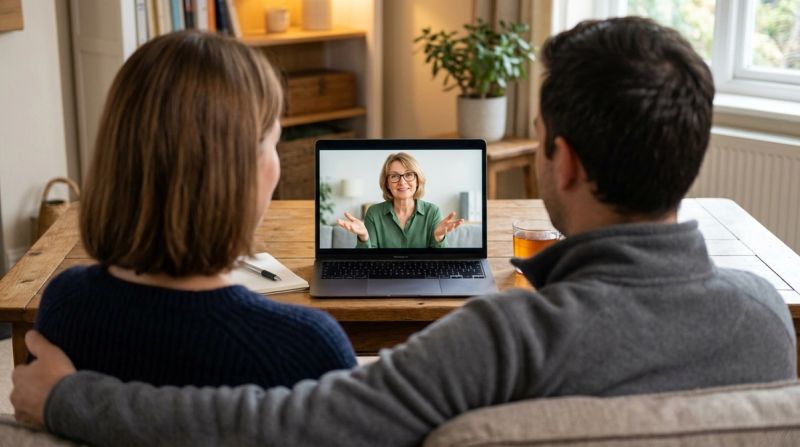
The online environment subtly but powerfully alters this biological dynamic. Engaging in therapy from the comfort of your own home provides a vital baseline of psychological safety. You are sitting on your own sofa, holding your own mug of tea, within a space that your primitive brain recognizes as a secure environment. This inherent, ambient comfort actively helps to keep the autonomic nervous system regulated. When your nervous system is calm, you are significantly more capable of engaging in active listening, rational processing, and empathetic responding.
Furthermore, the very nature and structure of a video conferencing call inherently forces a slower, more deliberate pace of conversation. Because slight audio lags and the inability to establish perfect, simultaneous eye contact make talking over one another difficult and confusing, couples are naturally compelled to wait their turn. This subtle technological constraint actually enforces a crucial, often-forgotten communication skill: the ability to pause and let the other person completely finish their thought before formulating and launching your response.
"The virtual space frequently acts as a vital, regulating container for couples in crisis. The screen provides just enough psychological and physical distance to prevent emotional flooding. It allows partners to stay mentally present in the difficult conversation without feeling physically overwhelmed, intimidated, or cornered by the other person's anger or distress. This distance often creates the safety required for true vulnerability."
For a deeper exploration of the data backing up this approach and how it compares to traditional settings, we recommend reviewing our comprehensive overview: Does Online Couples Therapy Actually Work? Evidence and Outcomes in Ireland.
Mastering the Art of Active Listening from Your Living Room
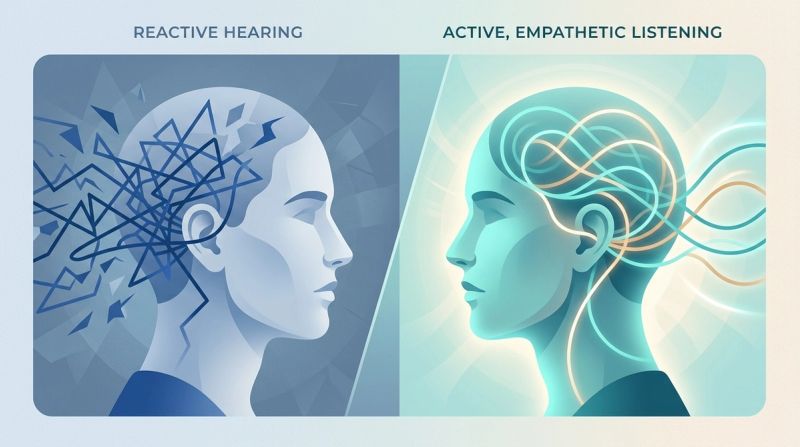
A foundational cornerstone of improving any relationship communication is learning and mastering the skill of "active listening." The harsh reality is that most of us do not listen to understand our partners; we listen merely to reply. We spend the entire time our partner is speaking silently constructing our rebuttal, searching for holes in their logic, and waiting for them to take a breath so we can launch our defense. Active listening requires a complete paradigm shift, and it is a tangible skill that is heavily practiced, refined, and tested during online couples therapy.
Active listening involves fully, intentionally concentrating on what is being said rather than just passively 'hearing' the words. It requires the immense discipline of suspending your own judgment, setting aside your personal agenda, and striving to truly comprehend your partner's unique perspective and emotional experience, even if you vehemently disagree with the factual basis of their narrative.
During an online session, your therapist will explicitly guide you through highly structured listening exercises. They will frequently ask one partner to speak on a specific topic while the other is tasked solely with listening. The listening partner is then required to accurately summarize and reflect back what they heard, without adding any of their own commentary, corrections, or defensive posturing. This process, while seemingly simple, is often profoundly difficult and deeply transformative for several reasons:
- Radical Validation: When you accurately and calmly reflect back what your partner has said, you are providing profound validation of their internal experience. You are signalling, "I hear you, I see you, and your feelings make sense to me from your perspective." Validation is the ultimate antidote to defensiveness and stonewalling.
- Immediate Clarification: Misinterpretations, assumptions, and mind-reading are the highly combustible fuel for most relationship fires. Active listening allows the speaking partner to correct any misunderstandings immediately, ensuring that both people are actually having the exact same conversation, rather than fighting two different phantoms.
- Natural De-escalation: It is incredibly difficult to remain highly agitated, aggressive, or resentful when you feel genuinely, deeply heard and understood by the person you love. Active listening naturally de-escalates nervous system tension and paves a clear runway for collaborative, rather than combative, problem-solving.
For couples navigating the devastating aftermath of complex emotional betrayals, where trust has been shattered and communication has entirely broken down into accusation and denial, mastering these active listening skills is the absolute first critical step toward any hope of recovery. To understand how these specific tools are applied in the most severe crisis situations, please read our dedicated guide on Healing After Infidelity: Can Online Couples Therapy Save Your Relationship?
Navigating Triggers and Managing Emotional Escalation with the "Virtual Time-Out"
Even with the absolute best intentions, a deep commitment to the process, and the safety of the home environment, discussions about deep-seated relationship issues, past hurts, and unmet needs will inevitably trigger emotional escalation. A skilled online therapist expects this volatility; they do not view it as a failure, but rather as the raw material of the therapy itself. They use the virtual format and their clinical expertise to help you manage these explosive moments constructively.
In a traditional face-to-face setting, a therapist might physically lean forward, use hand gestures, or physically stand up to halt a rapidly escalating argument. Online, the therapist uses sharp verbal cues, visual signals, and the structured authority of the session to hit the pause button. When an online therapist notices that one or both partners are becoming emotionally "flooded"—which is clinically indicated by raised voices, rapid, breathless speech, aggressive posturing toward the webcam, or conversely, completely shutting down and looking away—they will actively intervene to break the destructive cycle.
This intervention frequently involves calling a structured "virtual time-out." The therapist may ask both partners to physically step back from the screen, take a deep breath, ground themselves by noticing the physical sensations in their living room, and check in with their internal physiological state. They will teach you how to recognize your own unique, internal warning signs of flooding—such as a tightening in the chest, a racing pulse, or a sudden inability to focus—so that you can begin to self-regulate before the communication turns toxic and damaging words are spoken.
Learning how to respectfully pause a conversation when it becomes unproductive, and—crucially—agreeing on a specific time to return to the issue once both nervous systems have fully calmed down, is perhaps one of the most valuable, protective communication tools any couple can acquire. Online therapy provides a safe, guided, and supervised laboratory to practice this exact skill until it becomes second nature.
The Therapist as a Cultural and Emotional Translator
When communication patterns are deeply dysfunctional, partners often feel as though they are speaking entirely different languages, shouting across a vast canyon with no bridge. One person might be desperately expressing a need for emotional connection by complaining endlessly about a lack of help with household chores. The other partner, however, hears only relentless criticism regarding their competence and responds with angry withdrawal, which the first partner then interprets as cold, cruel abandonment. It is a cycle of mutual misinterpretation.
The online couples therapist acts as an essential, bilingual translator in this painful dynamic. Their clinical role is not to act as a judge, to take sides, or to decide who is objectively "right" about an event. Instead, their job is to decipher the underlying, vulnerable needs and deep-seated fears that are hidden beneath the harsh surface of the argument.
If Partner A angrily states to the screen, "You always prioritize your job over me, I am completely invisible to you," the therapist will intervene. They will help Partner A rephrase this attack using a vulnerable 'I' statement, shifting the focus from accusation to emotional disclosure: "I feel incredibly lonely, scared, and disconnected when you work late every evening, and I have a deep need for more quality time and reassurance from you."
Simultaneously, the therapist helps Partner B hear the soft vulnerability beneath the initial, hard accusation. They guide Partner B to respond to the underlying loneliness and fear, rather than defending their work ethic or arguing about the number of hours they billed that week. By consistently, relentlessly interrupting negative cycles and translating sharp attacks into soft expressions of vulnerable need, the therapist teaches the couple an entirely new, constructive language of connection.
"A highly significant portion of relationship therapy involves uncovering the primary emotions—like fear of abandonment, deep sadness, or a longing to be seen and valued—that are almost always masked by secondary, reactive, and protective emotions like anger, frustration, or apathy. When couples finally learn to communicate from that place of primary vulnerability, profound, lasting shifts occur in the relationship."
Integrating Communication Tools into Daily Domestic Life
The ultimate, overarching goal of any effective therapy is to render the therapist completely obsolete. The real, heavy lifting of improving communication does not happen during the fifty minutes you spend on a secure video call; it happens in the 167 hours between those sessions. This is another area where the online modality dramatically outshines traditional methods.
When you attend a therapy session in a downtown clinic, there is a distinct, geographical separation between the "therapy space" where you are calm and reflective, and your "real life" where the triggers exist. The brilliant insights gained in the clinical room can sometimes evaporate the moment you step out into the rain or hit traffic on the drive home. With online therapy, the learning takes place in the exact physical environment where the communication needs to happen and where the conflicts typically arise.

You learn how to have difficult, vulnerable conversations while sitting at your own kitchen table, on your own sofa, or in your own home office. This contextual, situational learning makes it significantly easier to integrate new communication tools directly into your daily domestic routine. Furthermore, your therapist will equip you with specific, actionable homework to practice between virtual sessions. This might include:
- Scheduling State-of-the-Union Check-ins: Setting aside twenty minutes a week for a structured, distraction-free conversation about the emotional state of the relationship, entirely separate from logistical discussions about paying bills, managing children, or planning holidays.
- Practising the 'Soft Start-Up': Learning how to raise a complaint or an issue gently and respectfully, without assigning blame or using harsh criticism. Research shows that discussions almost always end on the same tone they begin; mastering the soft start-up drastically increases the likelihood of a positive, collaborative response.
- Building a Culture of Appreciation: Actively combating the human tendency to focus on the negative by intentionally noticing, highlighting, and verbalising the positive things your partner does every single day, no matter how small.
If you are unsure of the practicalities of setting up an online session to ensure you have a private, distraction-free space to practice these tools, you can read our comprehensive logistical guide on Preparing for Your First Online Couples Therapy Session: A Practical Guide.
Conclusion: Rebuilding the Foundation of Your Relationship
Improving communication is not merely about learning how to argue better, nor is it about simply learning polite phrases to mask deep resentment. It is about fundamentally rebuilding the foundation of friendship, trust, and intimate emotional connection that sustains a healthy, long-term partnership. When you can communicate effectively and safely, you completely transform conflict. It changes from being a source of profound, terrifying damage into a unique opportunity for deeper understanding and closer connection.

Online couples therapy provides a highly effective, clinically proven, accessible, and psychologically safe pathway for Irish couples to break destructive historical cycles and learn the vital skills necessary for a thriving relationship. By engaging in this deeply rewarding work from the comfort and privacy of your own home, you are making a profound investment in the long-term health, stability, and happiness of your partnership.
To explore all the varied aspects of virtual relationship support, from detailed effectiveness data to transparent cost breakdowns and modality explanations, please navigate back to our central master guide: The Ultimate Guide to Online Couples Counselling in Ireland: Rebuilding Connection from Home.
If you recognize these negative communication patterns in your own daily interactions and feel ready to make a meaningful change, professional, empathetic support is readily available. Taking the first step towards better communication isn't just about fixing a problem; it is taking the first vital step back toward the person you love.