CBT for Phobias: How Exposure Therapy Works in Ireland

CBT and exposure therapy are the most effective treatments for phobias. Learn how they work, what sessions involve and how to start therapy in Ireland.
Conor had not been on a plane in eight years. It was not that he disliked holidays. He loved the idea of them. But every time he thought about booking flights, his mind supplied the same images: turbulence, trapped doors, the moment the runway disappeared beneath him. His heart rate would spike before he even opened the airline app.
He had tried coping strategies from YouTube videos and self-help books. He had downloaded breathing apps, listened to calming playlists and told himself the statistics were on his side. None of it made a lasting difference. The fear stayed, and his world stayed smaller than he wanted it to be.
If you are living with a phobia, Conor's story probably sounds familiar. The good news is that phobias respond exceptionally well to treatment. Cognitive behavioural therapy, particularly exposure therapy, is the approach most strongly supported by research. This article explains how CBT for phobias works in practice, what you can expect from sessions, and how to find the right support in Ireland.
What CBT for Phobias Actually Looks Like
Cognitive behavioural therapy, or CBT, is a structured, practical form of psychotherapy. It is based on the idea that our thoughts, feelings and behaviours influence one another. For someone with a phobia, the problem is not just the feared object or situation. It is also the avoidance, the catastrophic predictions and the physical panic response that keep the fear alive.
CBT for phobias typically involves two main elements:
- Cognitive work — identifying and gently challenging the thoughts that fuel the fear. This might include beliefs like "I will definitely faint," "I will lose control" or "Something terrible will happen."
- Behavioural work — gradually reducing avoidance and learning that the feared situation is survivable. This is where exposure therapy comes in.
The goal is not to talk you out of being afraid. It is to help your nervous system update its threat assessment. As the HSE notes, talking therapies such as CBT are recommended for anxiety disorders, including specific phobias.
How Exposure Therapy Works
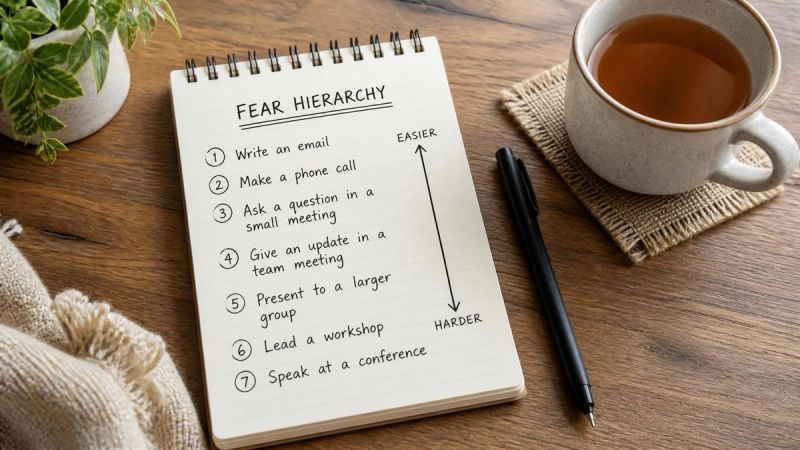
Exposure therapy sounds intimidating, but it is not about throwing you into your worst fear and hoping for the best. It is a gradual, controlled process. You and your therapist work together to build a "fear hierarchy" — a list of situations related to your phobia, ranked from least to most anxiety-provoking.
For someone with a fear of flying, the hierarchy might look like this:
- Looking at photos of aeroplanes
- Watching videos of take-offs
- Visiting an airport without flying
- Sitting on a stationary plane
- Taking a short flight with support
You start with the easiest item and stay with it until your anxiety decreases. Then you move to the next one. This process teaches the brain that the feared outcome does not happen, and that anxiety itself rises and falls naturally. Over time, the panic response weakens.
The therapist's role is to keep the process safe and structured. They will not ask you to do anything you have not agreed to, and they will help you notice when your anxiety is starting to drop. Many people are surprised to find that their peak anxiety lasts only a few minutes, even though it can feel endless in the moment.
Research published by the National Institute for Health and Care Excellence supports graduated exposure as part of CBT for anxiety disorders. Studies consistently show that exposure therapy is one of the most effective treatments for specific phobias, with many people experiencing significant improvement in a relatively short number of sessions.
Dr. Paul Salkovskis, professor of clinical psychology at the University of Oxford, has described the process clearly:
"Exposure is not about proving you're brave. It is about giving yourself the chance to discover that the thing you fear is not as dangerous as your mind has told you it is."
What a Typical Session Involves
A typical CBT session for a phobia lasts around 50 to 60 minutes. In the first session, your therapist will usually take a detailed history of the phobia, when it started, how it affects your life and what you have tried before. They will also check whether there are other conditions present, such as generalised anxiety, panic disorder or depression, as these can shape the treatment plan.
After the assessment, the work usually follows a clear structure:
- Psychoeducation — understanding how phobias develop and why avoidance keeps them going.
- Building a hierarchy — ranking feared situations from manageable to challenging.
- Learning coping skills — grounding techniques, breathing strategies and ways to tolerate anxiety without avoiding it.
- Graded exposure — working through the hierarchy in and between sessions.
- Relapse prevention — planning how to maintain progress after therapy ends.
Between sessions, you may be given small practice tasks. These are not random homework exercises. They are carefully chosen steps that help you build confidence at the right pace.
Does Online CBT Work for Phobias?
Yes. Online CBT can be effective for phobias, provided it is delivered by an accredited therapist and includes structured exposure work. A 2022 review in the journal Internet Interventions found that guided internet-based CBT produced meaningful improvements for anxiety disorders, including phobic anxiety.
For many people in Ireland, online therapy has practical advantages. You can attend sessions from home, which is especially helpful if your phobia involves leaving the house, travelling or sitting in waiting rooms. It also removes the need to commute, which can be a barrier if you are anxious about driving or public transport.
At Feel Better Therapy, online CBT sessions are delivered by accredited Irish therapists. The format allows for the same structured exposure planning, real-time support and between-session tasks you would expect from in-person care.

What to Look for in a CBT Therapist in Ireland
Not every therapist who offers CBT has specific training in exposure therapy for phobias. When choosing someone, it is worth asking a few practical questions.
- Are they accredited with a recognised Irish body, such as the Irish Association for Counselling and Psychotherapy (IACP), the Psychological Society of Ireland (PSI) or the Irish Council for Psychotherapy (ICP)?
- Do they have experience working with phobias and anxiety disorders?
- Do they offer structured, evidence-based CBT rather than general supportive counselling?
- Are sessions available online if that suits your needs?
Accreditation matters because it means the therapist has met recognised training and ethical standards. The IACP and PSI both have online directories where you can search for accredited therapists by location and specialism. Many people also prefer to work with a therapist who understands the Irish context, including HSE pathways, waiting lists and local services.
It is also reasonable to ask how many sessions the therapist typically works with for phobias, whether they set clear goals, and how they measure progress. A good CBT therapist will be happy to explain their approach.

How Long Does Treatment Take?
The length of treatment depends on the phobia, its severity and how much it has affected your life. Many specific phobias respond well to short-term CBT, sometimes in as few as 6 to 12 sessions. More complex phobias, such as agoraphobia or social phobia, may take longer, particularly if they are linked to other difficulties such as panic disorder or depression.
What matters most is consistency. Avoidance is what keeps a phobia strong. Each time you approach rather than avoid, you weaken the fear. Therapy gives you a safe structure for doing that, at a pace that feels manageable.
If you are unsure whether your fear counts as a phobia or whether CBT is right for you, a brief consultation with a therapist can help clarify the next step. You do not need to have everything figured out before you reach out.

Frequently Asked Questions
Is exposure therapy safe?
Yes, when delivered by a trained therapist. The process is gradual and collaborative. You are in control of the pace, and your therapist supports you through each step.
Will I be forced to face my fear all at once?
No. Exposure is graded, meaning you start with the least anxiety-provoking step and move up slowly. Rushing the process usually backfires.
Can CBT cure a phobia?
Many people find that their phobia reduces dramatically or disappears altogether after CBT. The aim is to reduce fear and avoidance to the point where the phobia no longer controls your life.
Do I need a GP referral for CBT in Ireland?
No. You can access private CBT directly. Some people also receive CBT through HSE services or their GP, though waiting times can vary by area.
What if I have more than one phobia?
A therapist can help you prioritise which phobia to address first. Often, treating one fear builds confidence that makes it easier to tackle others later.
You Don't Have to Keep Avoiding It
A phobia can feel like a life sentence, especially if you have organised your days around dodging the thing you fear. But the brain that learned to be afraid can also learn to feel safe again. CBT and exposure therapy provide a clear, evidence-based path for doing exactly that.
If you are ready to take the next step, you can explore CBT therapy with Feel Better Therapy and get matched with a therapist who has experience treating phobias. Help is available, and you do not have to figure it out alone.
Related Articles
- What Is a Phobia? Signs, Symptoms and Types in Ireland
- Agoraphobia in Ireland: When Fear Keeps You Inside
- Dental Phobia: Overcoming Fear of the Dentist in Ireland
This article is for informational purposes only and does not constitute medical advice. If you are in crisis, please contact Samaritans Ireland at 116 123 or your GP.